Culture · July 2026
Something to Say
Five artists and movements that were making a philosophical claim, not just a painting. What they believed art was for, in their own words, through their actual work.
Five answers to one question
The work changed when the location of meaning changed.
I drew this as a map of pressure: the rule each one inherited, the lever they pulled, and the new job left to the viewer.
The inherited rule
Serious art proves itself through difficulty
What they changed
Use violent color in the service of rest
Where meaning moved
Sensation
What that asks of you
Joy becomes something you can work at, not an escape from the work
These categories are my interpretation. Each section below keeps the artist's own words and the museum record beside it.
MoMA on the cut-outsMatisse: Joy Is Not Decorative
Henri Matisse
1869–1954, Le Cateau-Cambrésis to Nice
Matisse spent sixty years arguing that joy was a serious artistic position. Critics called him decorative. He outlasted every one of them.
In 1908, Matisse published “Notes of a Painter” in La Grande Revue. It is the closest thing he wrote to a manifesto, and it stakes the entire claim in one sentence:
“What I dream of is an art of balance, of purity and serenity, devoid of troubling or depressing subject matter, an art which could be for every mental worker, for the businessman as well as the man of letters, for example, something like a good armchair in which to rest from physical fatigue.”
Henri Matisse, “Notes of a Painter,” La Grande Revue, 25 December 1908
Reprinted in Jack Flam, ed., Matisse on Art (Phaidon, 1995)
The armchair line got him decades of condescension. “Decorative” became the word they reached for, as though serenity were a lesser ambition than suffering. But the Fauves (les fauves, the wild beasts, named by a hostile critic at the 1905 Salon d’Automne) were not tame. They used color at a violence that had no precedent. The difference was that Matisse directed the violence toward joy instead of anguish.

Henri Matisse, Bathers with a Turtle, 1907–08
Saint Louis Art Museum · public domain · Wikimedia Commons
The Red Room (Harmony in Red), 1908
Started as Harmony in Blue. Matisse repainted the entire canvas because blue was not what the room wanted to say. The red flattens the distinction between table and wall: the pattern continues across both, and depth becomes irrelevant. The room is not depicted. It is declared.
Bathers with a Turtle, 1907–08
Three figures sit around a small turtle with a quality of attention that has nothing to prove. The composition strips out everything that is not the act of looking. MoMA Gallery 506.
The Dance, 1910
Five figures, two colors, no ground. The bodies are not performing dance; they are the verb itself. Commissioned by Sergei Shchukin for his Moscow staircase.
“There is nothing more difficult for a truly creative painter than to paint a rose, because before he can do so he has first to forget all the roses that were ever painted.”
Henri Matisse, in conversation, reported by Louis Aragon
Henri Matisse: A Novel, trans. Jean Stewart (Harcourt, 1971)
The late cut-outs, made from his wheelchair with painted paper and scissors, are the final proof. He could no longer hold a brush. So he cut directly into color, and the work got bigger, not smaller. The Snail (1953), at nearly nine feet, is a spiral of pure color blocks with no line drawing at all. He called it “painting with scissors.” The medium changed; the position did not.
Duchamp: The Artist Decides
Marcel Duchamp
1887–1968, Blainville-Crevon to Neuilly-sur-Seine
Duchamp argued that art lives in the decision, not in the object. He spent the second half of his life playing chess and letting the argument win on its own.
“I was interested in ideas — not merely in visual products.”
Marcel Duchamp, in Pierre Cabanne, Dialogues with Marcel Duchamp (1967)
Trans. Ron Padgett (Da Capo Press, 1987)
In 1913, Duchamp mounted a bicycle wheel on a kitchen stool and watched it spin. By 1917, he bought a urinal from the J. L. Mott Iron Works in New York, signed it “R. Mutt,” and submitted it to the Society of Independent Artists exhibition. They rejected it. The rejection was the point. If the artist’s choice is what makes art, then the institution that refuses the choice has just proved the argument.

Marcel Duchamp, Fountain, 1917
Photograph by Alfred Stieglitz · public domain · Wikimedia Commons
Fountain, 1917 (original lost; 1964 replica, Tate Modern)
A porcelain urinal, rotated 90 degrees, signed R. Mutt. The most influential artwork of the twentieth century by one common reckoning, and it is an object Duchamp did not make. He chose it.
The Bride Stripped Bare by Her Bachelors, Even (The Large Glass), 1915–23, declared ‘definitively unfinished’
Nine feet of oil, varnish, lead foil, and wire on two glass panes. The glass cracked during transport in 1926. Duchamp reassembled the shattered pieces within a new frame and called that the finished work.
L.H.O.O.Q., 1919
A postcard of the Mona Lisa with a pencil mustache and goatee. The title, read aloud in French, sounds like ‘elle a chaud au cul’ (she has a hot ass). Da Vinci’s masterpiece reduced to a pun in thirty seconds.
“The creative act is not performed by the artist alone; the spectator brings the work in contact with the external world by deciphering and interpreting its inner qualifications and thus adds his contribution to the creative act.”
Marcel Duchamp, “The Creative Act,” address to the American Federation of Arts, Houston, April 1957
Published in ARTnews, vol. 56, no. 4 (Summer 1957)
After The Large Glass, Duchamp told the world he had retired from art to play chess full-time. He played in the French national team. He designed chess sets. For twenty years, everyone believed him. Then, after his death in 1968, the Philadelphia Museum of Art revealed Étant donnés (1946–66): a secret installation he had been building in his studio for two decades while claiming to make nothing at all. The retirement was itself a readymade.
Rothko: Silence Is So Accurate
Mark Rothko
1903–1970, Daugavpils (Latvia) to New York
Rothko painted feelings so large they needed to be taller than the viewer. He refused to call them abstractions, because the emotions in them were the most concrete things he knew.
“I am not an abstractionist. I am not interested in the relationship of color or form or anything else. I am interested only in expressing basic human emotions — tragedy, ecstasy, doom, and so on. And the fact that a lot of people break down and cry when confronted with my pictures shows that I can communicate those basic human emotions.”
Mark Rothko, lecture at Pratt Institute, 1958
Cited in James E. B. Breslin, Mark Rothko: A Biography (University of Chicago Press, 1993)
By 1950, Rothko had arrived at the format he would keep for the rest of his life: two or three soft-edged rectangles of color, stacked vertically, hovering on a larger field. No line. No figure. No title (he stopped titling them, using only numbers or colors). He insisted the paintings be hung low, in dim light, in small rooms, so the viewer would be enveloped rather than surveying from a distance.
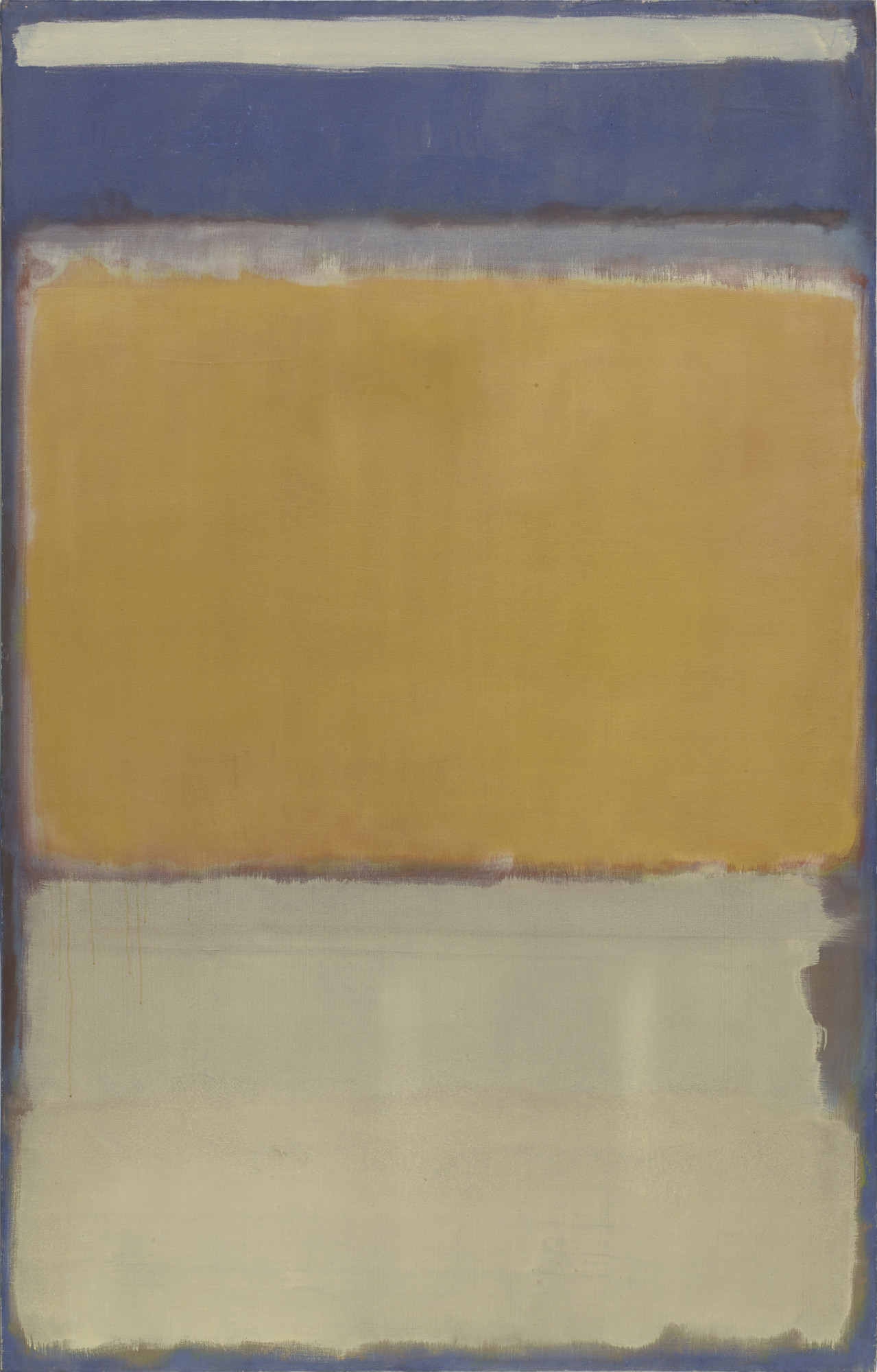
Mark Rothko, No. 10, 1950
Gift of Philip Johnson · Copyright Kate Rothko Prizel & Christopher Rothko / ARS · The Museum of Modern Art
No. 61 (Rust and Blue), 1953
Rust over blue, nearly eight feet tall. The edges breathe. Rothko wanted you to stand eighteen inches from the surface, close enough that the painting becomes your entire visual field.
The Seagram Murals, 1958–59
Commissioned for the Four Seasons restaurant in the Seagram Building, New York. Rothko accepted, then visited the finished restaurant, and returned the commission. He said he wanted his paintings to make the diners feel trapped. The restaurant was too comfortable. He kept the paintings.
Rothko Chapel, 1964–67, opened 1971
Fourteen paintings in a nondenominational chapel in Houston, commissioned by John and Dominique de Menil. The canvases are nearly black. The light shifts through the day and the paintings change with it. Rothko did not live to see it open.
“The people who weep before my pictures are having the same religious experience I had when I painted them. And if you, as you say, are moved only by their color relationships, then you miss the point.”
Mark Rothko, in conversation
Cited in Breslin, Mark Rothko: A Biography (1993)
The late paintings darken. The reds become maroons, the oranges become browns, the blues become black. The Rothko Chapel canvases are the end of the sequence: color pulled so deep into itself that the surface becomes a threshold. You are not looking at a painting. You are standing at the edge of something.
Dali: The Subconscious Made Visible
Salvador Dalí
1904–1989, Figueres to Figueres
Dali painted what rational sight cannot reach and rendered it so precisely that the viewer has no choice but to accept it as real. He was expelled from the Surrealists for it. He kept going.
“The difference between me and a madman is that I am not mad.”
Salvador Dalí, Diary of a Genius (1964)
Trans. Richard Howard (Solar Books, 2007)
Dali called his method the “paranoiac-critical method”: a systematic derangement of perception, controlled enough to paint, wild enough to see what rational sight cannot. He read Freud before he met him (they met in London in 1938; Freud, who had dismissed the Surrealists, conceded that Dali was worth studying). The technique is hyper-academic. The content is dreams, phobias, and obsessions rendered with the precision of a Vermeer interior.
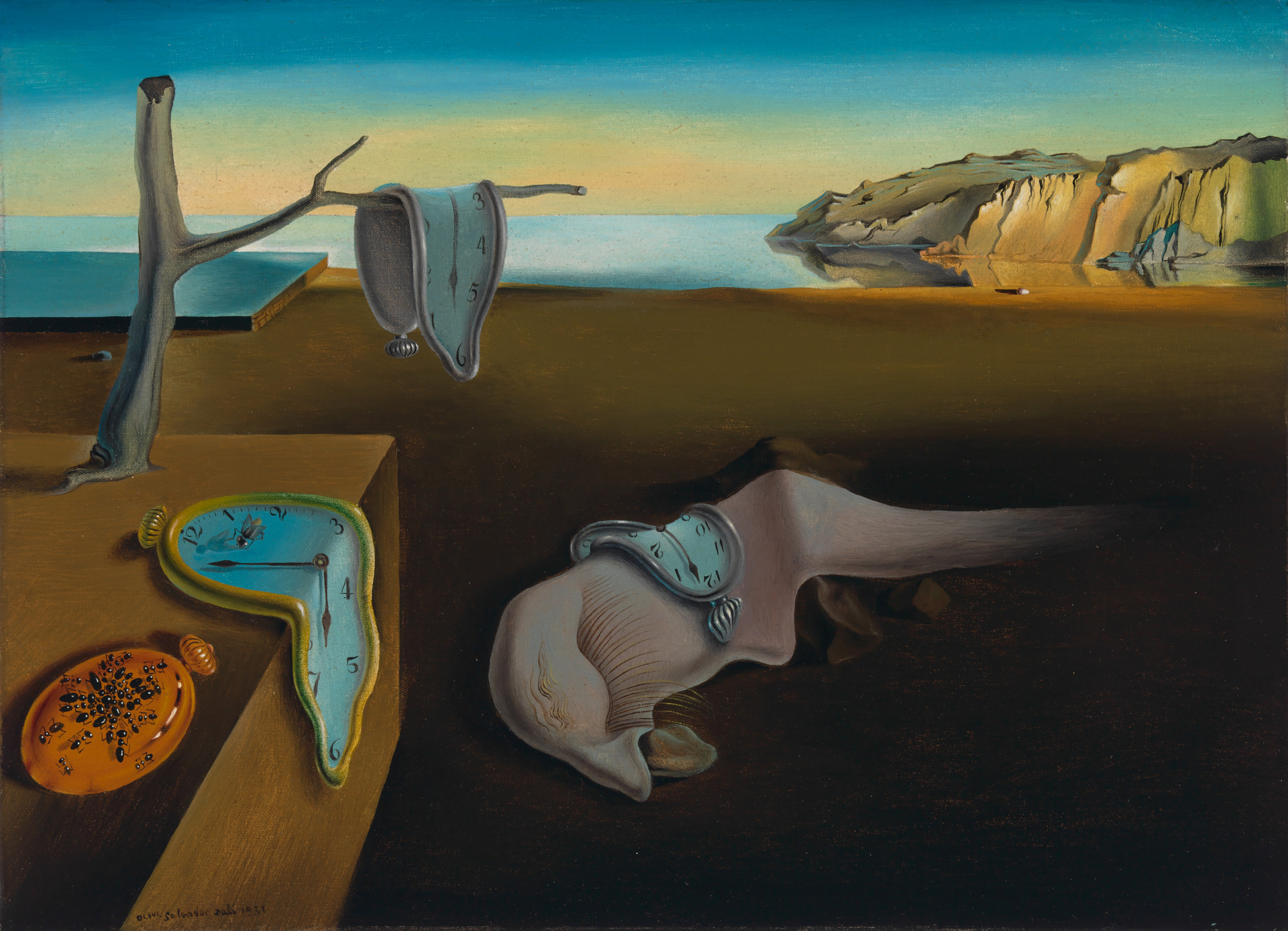
Salvador Dalí, The Persistence of Memory, 1931
Given anonymously · Copyright Gala-Salvador Dalí Foundation / ARS · The Museum of Modern Art
The Persistence of Memory, 1931
Melting watches draped over a dead tree and a fetal face on a barren coast. Eleven inches wide. It argues that time itself is soft, biological, and subject to decay. MoMA permanent collection.
The Elephants, 1948
Two elephants on impossibly long, spindly legs carry obelisks on their backs across a burnt desert. The legs are the argument: power is more fragile than it appears. The heavier the burden, the thinner the support.
Christ of Saint John of the Cross, 1951
The crucifixion seen from above and behind, looking down at the cross from the perspective of God. No nails, no blood, no suffering visible. The figure floats over the bay of Port Lligat. Classical technique in service of a vision no classical painter would have attempted.
“I do not understand why, when I ask for a grilled lobster in a restaurant, I am never served a cooked telephone.”
Salvador Dalí, quoted in dawn ades, dalí (Thames & Hudson, 1982)
Dali was expelled from the Surrealist group in 1934 by André Breton, who accused him of fascist sympathies and commercialism. Dali’s response: “I myself am Surrealism.” He went on building the Teatro-Museo Dalí in Figueres, which he designed as his own tomb and final artwork. He is buried in the crypt beneath the stage. He was born in Figueres and he died in Figueres and the building that holds his body is the last thing he made.
The Washington Color School: Color Is the Entire Subject
Painters working in Washington from the late 1950s onward pushed a position Matisse had pointed toward: color could carry the structure of a painting. They did not share one mechanism. Stain, stripe, brush mark, folding, gravity, and the viewer’s movement each made a different argument.
The catalyst was a studio visit. In 1953, the critic Clement Greenberg brought Morris Louis and Kenneth Noland to Helen Frankenthaler’s New York studio, where they saw Mountains and Sea (1952): paint thinned to a stain, poured directly onto unprimed canvas so the color soaked into the fabric rather than sitting on top of it. Louis and Noland returned to Washington and spent the next decade working out what that technique meant.
For Louis and Noland, stain could reduce the visible brush gesture: color soaked into the canvas instead of sitting on top of it. But that is one branch, not the whole school. Thomas built mosaics through repeated marks; Gilliam folded and draped stained canvas; Davis made stripe intervals unfold as the eye moved. What they shared was not the disappearance of the hand. It was a conviction that color relationships could organize the encounter.
The artists
Morris Louis
1912–1962 · Stain painting, poured Magna acrylic on raw canvas
Kenneth Noland
1924–2010 · Hard-edge, concentric circles and chevrons
Alma Thomas
1891–1978 · Mosaic-like dabs of pure color
Sam Gilliam
1933–2022 · Draped, unstretched stained canvas
Gene Davis
1920–1985 · Vertical stripe paintings
The work
Morris Louis, Beta Upsilon, 1960
Museum purchase from the Vincent Melzac Collection · Smithsonian American Art Museum
Kenneth Noland, Split, 1959
Gift from the Vincent Melzac Collection · Smithsonian American Art Museum
Alma Thomas, Aquatic Gardens, 1973
Bequest of the artist · Smithsonian American Art Museum
Sam Gilliam, April 4, 1969
Museum purchase · Smithsonian American Art Museum
Gene Davis, Hot Beat, 1964
Gift of the Woodward Foundation · Smithsonian American Art Museum
“Through color, I have sought to concentrate on beauty and happiness, rather than on man’s inhumanity to man.”
Alma Thomas, in an interview
Cited in exhibition catalog, Alma Thomas, ed. Seth Feman and Jonathan Frederick Walz (Columbus Museum of Art / Yale University Press, 2016)
The Washington Color School painted at the Phillips Collection, exhibited at the Corcoran (now folded into the National Gallery and George Washington University), and lived in a city that was not the center of the art world and did not try to be. Alma Thomas painted from her house on 15th Street NW. Morris Louis painted in a small house in Northwest DC and would not let visitors into his studio. The work did not need New York. It needed color, canvas, and a position about what a painting is for.
The throughline
Matisse said joy is not decorative; it is the hardest position to hold.
For Duchamp, the object was irrelevant. The artist’s decision is the art.
Rothko: abstraction is the wrong word. The emotion is the most concrete thing in the room. People wept. He said good.
Dalí rendered the impossible so precisely the viewer had to accept it as real.
The Washington painters stripped everything that was not color and checked whether the painting still held. It held.
They were all answering the same question I keep circling: what is a painting allowed to be? They answered it the same way, by making the one they were told was not allowed.
Where to see them in DC
The Phillips Collection
Rothko Room
Hirshhorn Museum
Color Field collection
National Gallery of Art
Matisse cut-outs, Rothko
Smithsonian American Art Museum
Alma Thomas
National Museum of Women in the Arts
Thomas, Frankenthaler
Your walk home
15th St NW
Continues in
The Red Room
Gallery 506 at MoMA, July 5. Matisse, Duchamp, six philosophers, and dismantling the apartment before Chicago.
The personal →Devotion & Poetry
The Bhakti poets, the Gita, and seven thinkers who said the same thing across two millennia.
The tradition →On Ambition
The founder appetite read through Marx, Fromm, Aristotle, Arendt, and the Gita.
The work →