Quandaries · July 2026
The Red Room
Gallery 506, MoMA, July 5. Matisse remains one of the great joy-givers. Duchamp wanted to change and never repeat himself. I built my apartment into a museum of memories and now I am taking it all down.
Gallery 506
You walk into a room and sometimes the room is already about you before you know why. MoMA, third floor, 3:49 in the afternoon. Gallery 506 is Henri Matisse. The wall label, curated by Ann Temkin with Jennifer Harris, describes an artist who wanted painting to be “an art of balance, of purity and serenity, devoid of troubling or depressing subject matter.”
MoMA · Gallery 506
“Matisse remains one of the great joy-givers of the twentieth century.”
Wall label, Gallery 506, The Museum of Modern Art
The Fauvist landscapes burn with color that has nothing to prove. Bathers with a Turtle (1907–08) sits three figures around something small and alive, and the whole painting is about the quality of attention they give it. The joy-giver. I stood there and thought: that is the job description.

Henri Matisse, Bathers with a Turtle, 1907–08
Saint Louis Art Museum · public domain · Wikimedia Commons
Matisse’s Rooms
Matisse painted The Red Room (Harmony in Red) in 1908. It started as Harmony in Blue. He repainted the entire thing because blue was not what the room wanted to say. The decision was not revision; it was an act of will. The room had to be red because red is the color that does not recede. It comes to you.
He spent his career refusing to suffer for his art. He spent it insisting that suffering was not the prerequisite. Painting, he said, should be “something like a good armchair in which to rest from physical fatigue.” Critics called him decorative, as though joy were a lesser ambition than torment. He ignored them for sixty years.
The red room is not an interior. It is a position. The position is: I will make this space exactly what I need it to be, and I will not apologize for the fact that what I need it to be is beautiful.
What the Room Carries
Harmony in Red is 71 by 87 inches. Seven objects in it, and every one of them is load-bearing.

Henri Matisse, The Red Room (Harmony in Red), 1908
State Hermitage Museum · public domain · Wikimedia Commons
The red
Carried from blue. Shchukin commissioned Harmony in Blue. Matisse delivered it blue and repainted the entire canvas because blue was not what the room wanted to say. The red carries the refusal to deliver what was asked for.
The arabesque
Flows identically across the tablecloth and the wall behind it. Where the table ends and the wall begins is unanswerable. The pattern carries the argument that there is no depth here, only surface, and surface is enough.
The woman
Arranging fruit, turned away from the viewer. She is not posing. She is not performing attention. She is attending, and the painting's only interest in her is the quality of that attention.
The decanters
Two glass carafes of wine on a table that might also be a wall. The domestic elevated to the monumental without changing anything about it. The armchair: rest without apology.
The fruit
Oranges and lemons, loose on the table, spilling from a compote. The Fauve palette in edible form. Real food rendered as pure color, which is what the Fauves always said color was: a thing you taste before you analyze.
The window
The only aperture to the garden outside. Flowering trees, a green hill, a small figure. But the window reads as flat as the wall. The real world, seen from the red room, is also decorative.
The chair
Barely there, lower left, half-absorbed into the pattern. It carries the armchair line, the one that got him decades of condescension. A good armchair in which to rest. He left it in the painting as a dare.
Seven objects, each one carrying the same argument: the room is not depicting life. The room is life. The distinction between the beautiful and the real is the one thing Matisse refused to draw.
The Room I Built
Someone asked me what catalyzed my change and the answer was therapy, but it was also building my home. Spending hours just looking at it and perfecting it. The apartment became an origin object, not a book or a painting but a space I made legible to myself.
In my own words
It was building my home and spending hours just looking at it and perfecting it. And even now, in taking it all down, I find it to be so motivational. And I am so proud of myself because I know that it was the last thing I wanted to do in so many ways. It hurts me to see my world start to shrink around me.
In On Love, I wrote about wanting someone to build a world with me, “complete with a museum of memories: adventures, laughing, being present.” I did not wait. I built the museum anyway. Every shelf was a choice. Every wall was a statement about what kind of life I believed I deserved.
Now I am packing it into boxes for Chicago, and the packing is not the opposite of the building. It is the same muscle. Matisse repainted blue into red because the room had to change. I am dismantling a room I loved because I have to change. The imperative is the same.
The museum of memories
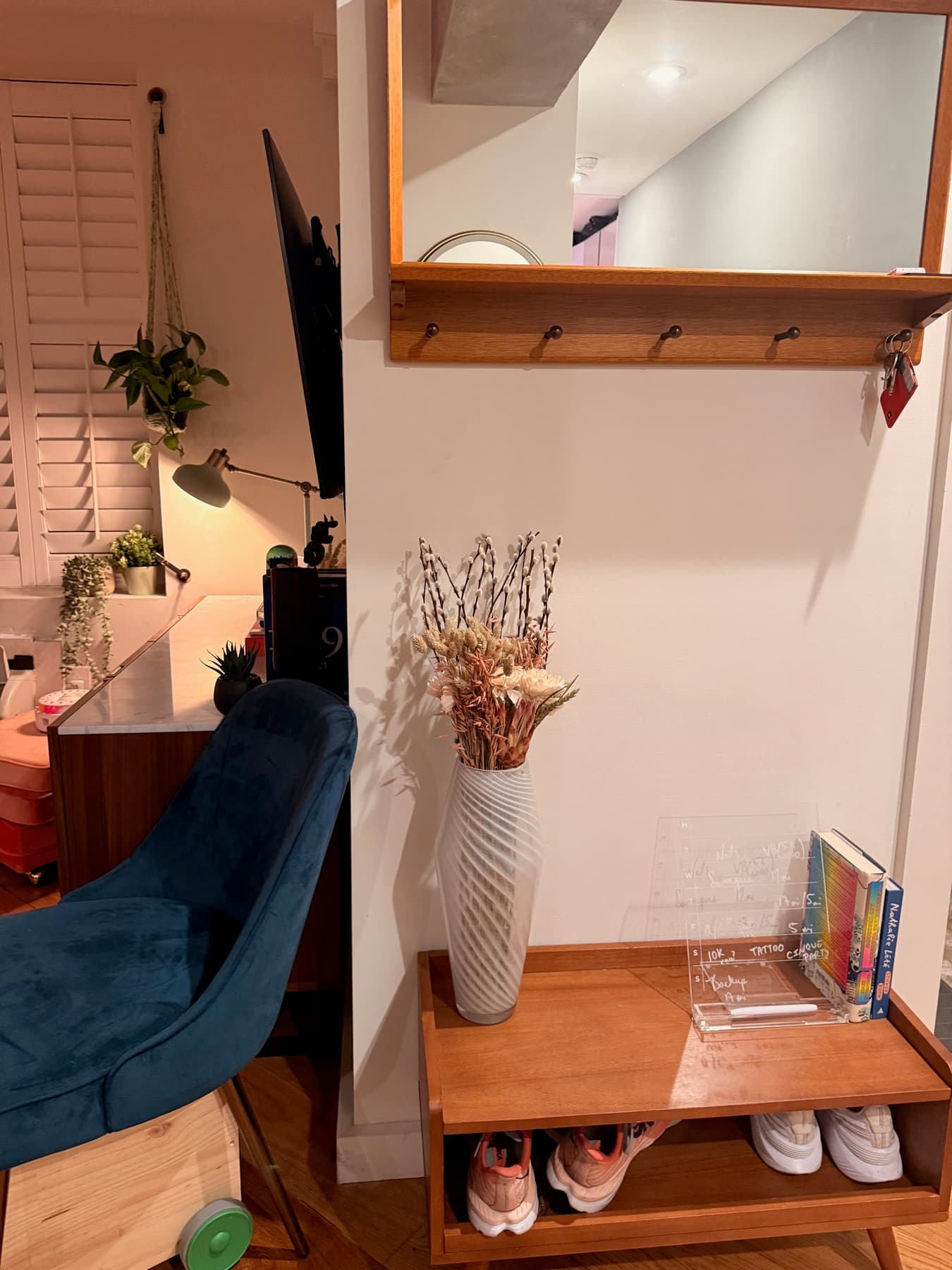
The threshold
Dried flowers, the blue chair, running shoes by the door. The room starts here.
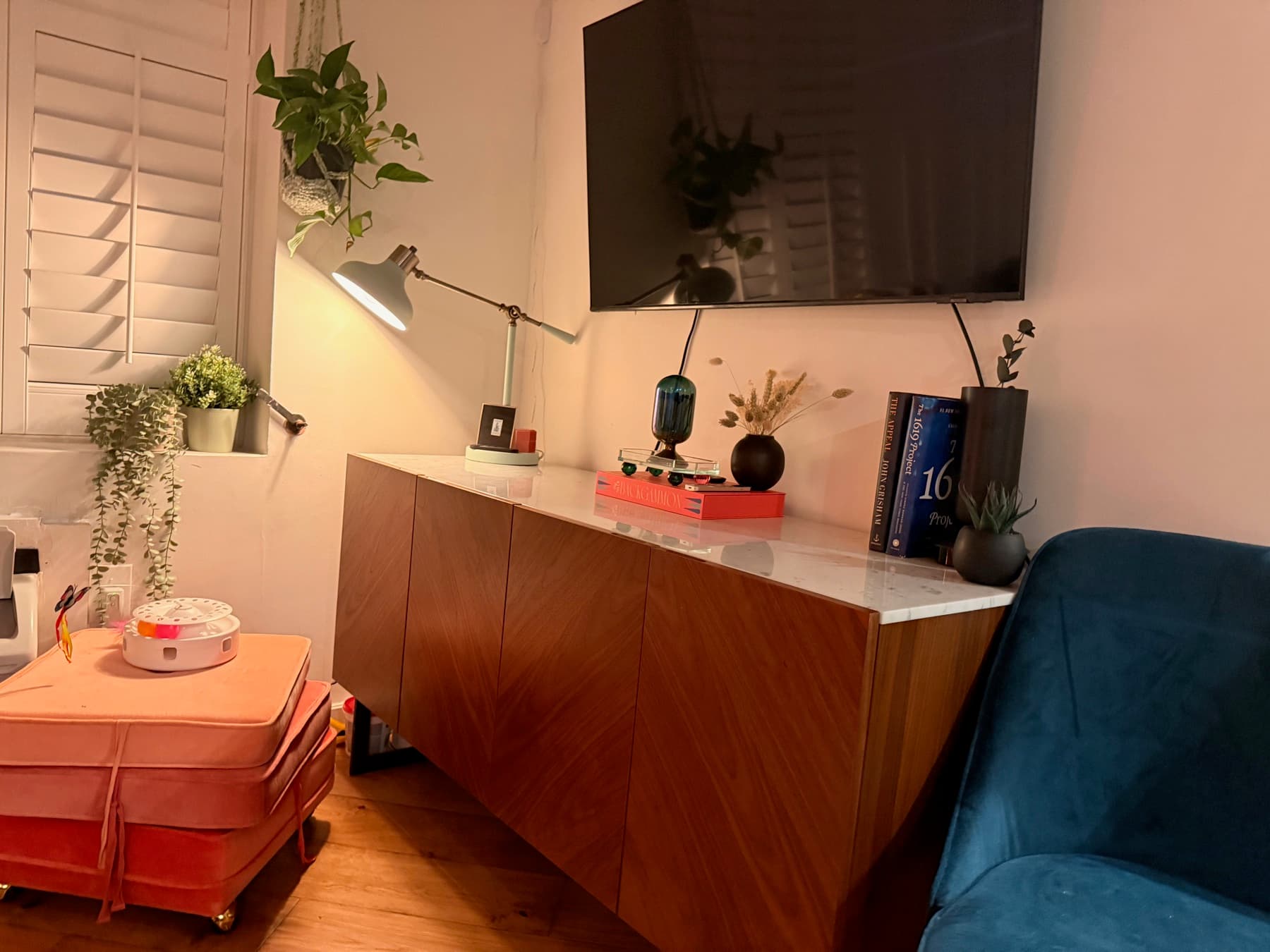
The arrangement
Hanging plants, the credenza, warm light. A room that does not recede.
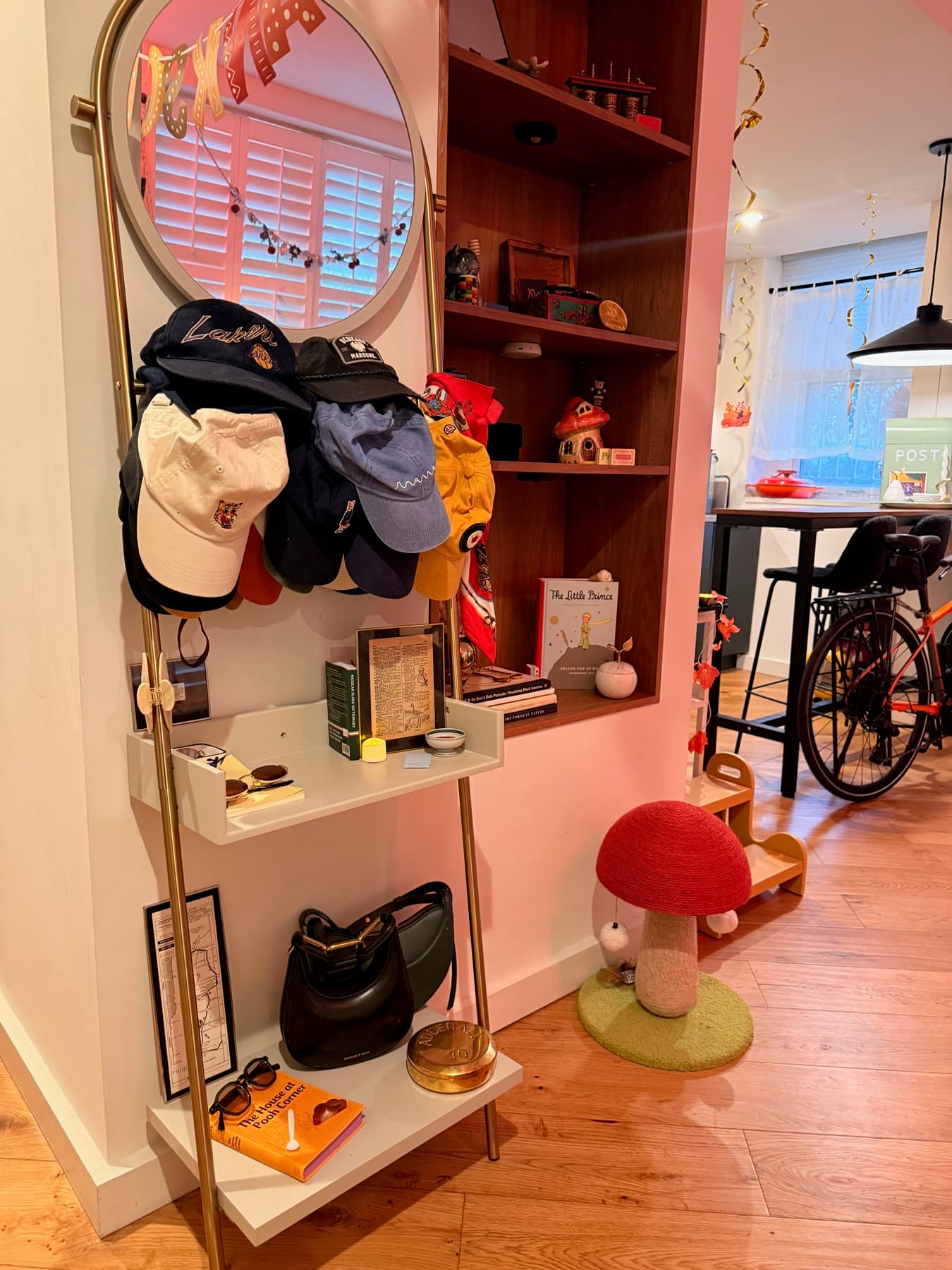
The room
Every shelf was a choice. Every wall was a statement about what kind of life I believed I deserved.
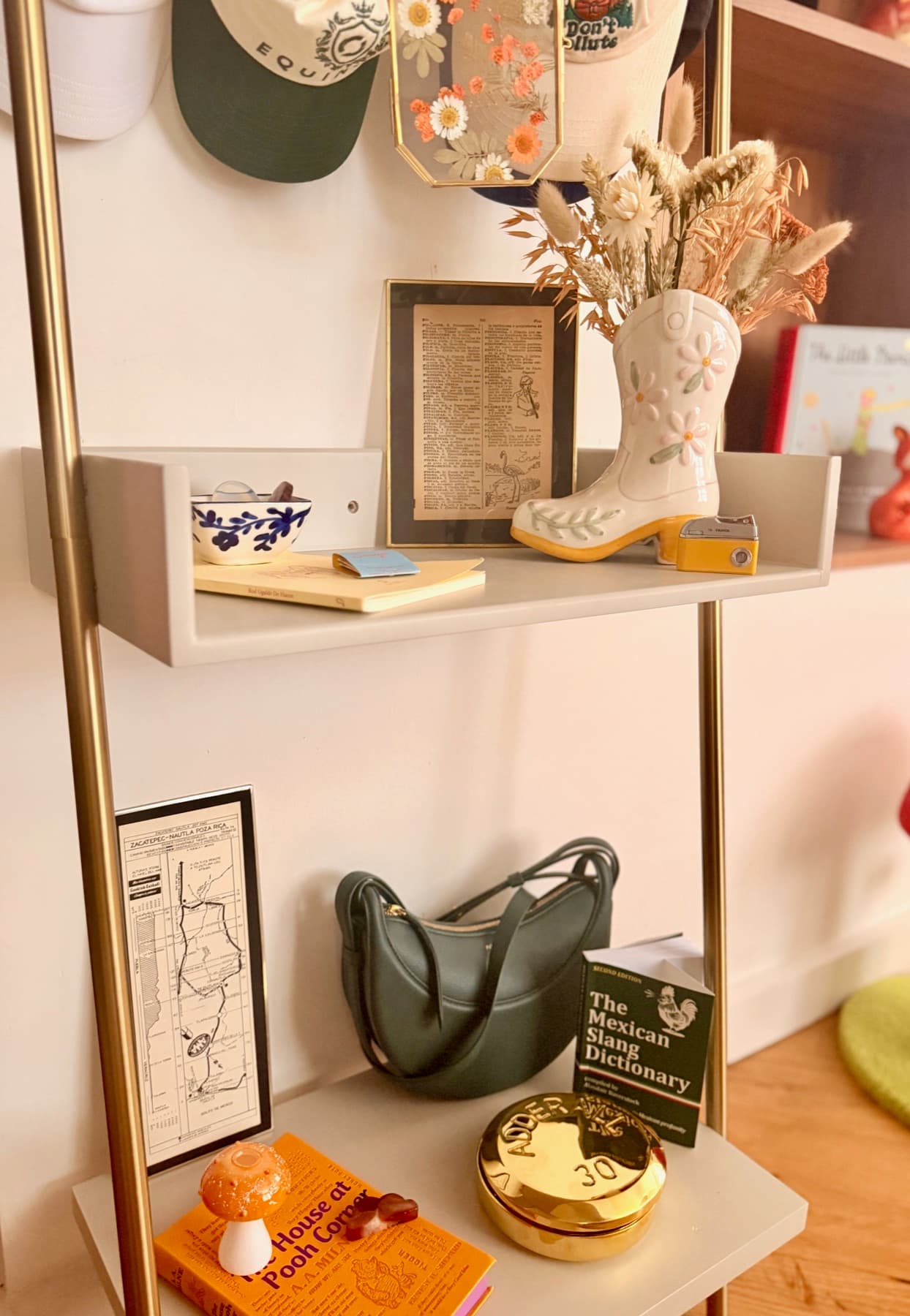
The objects
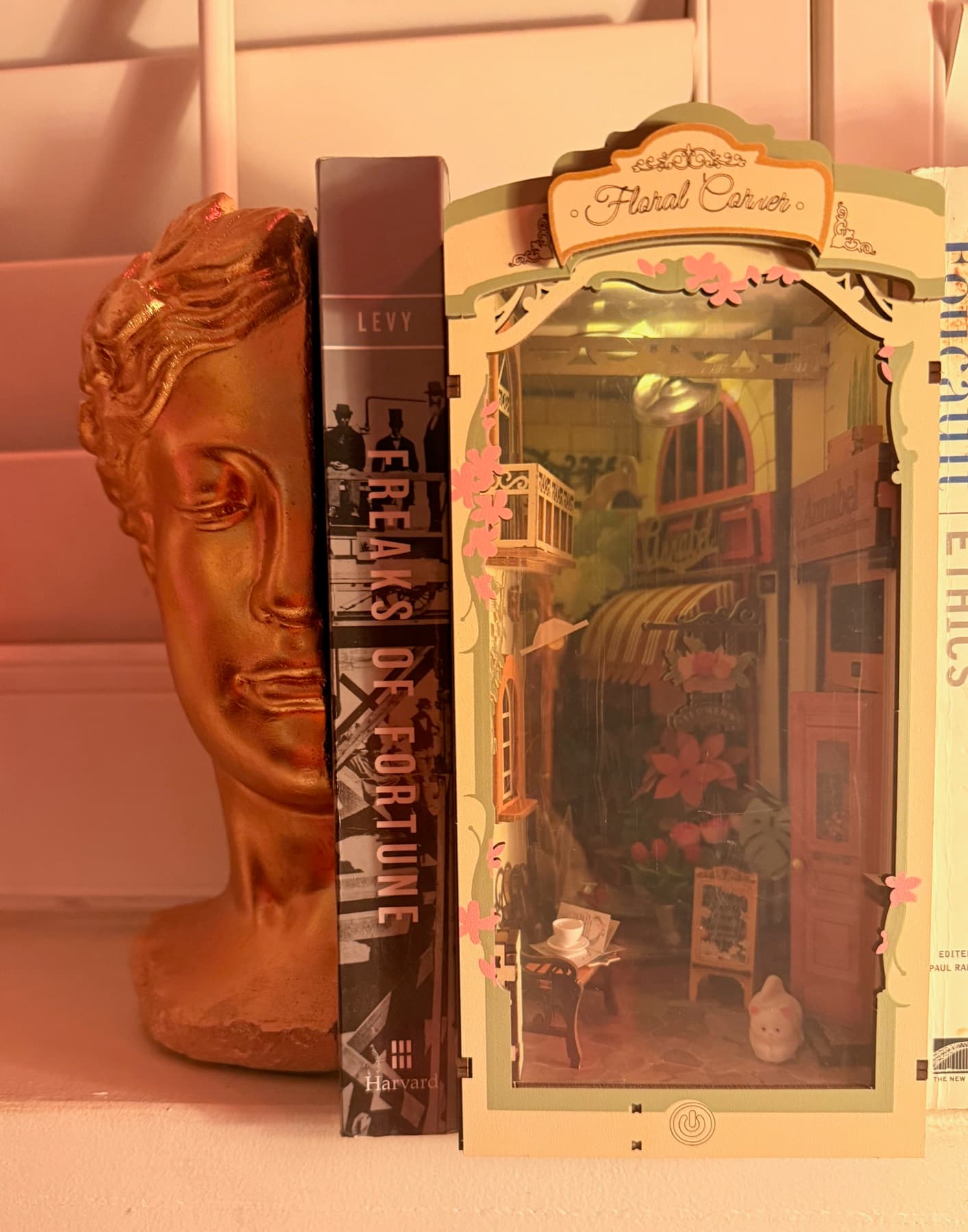
The collection
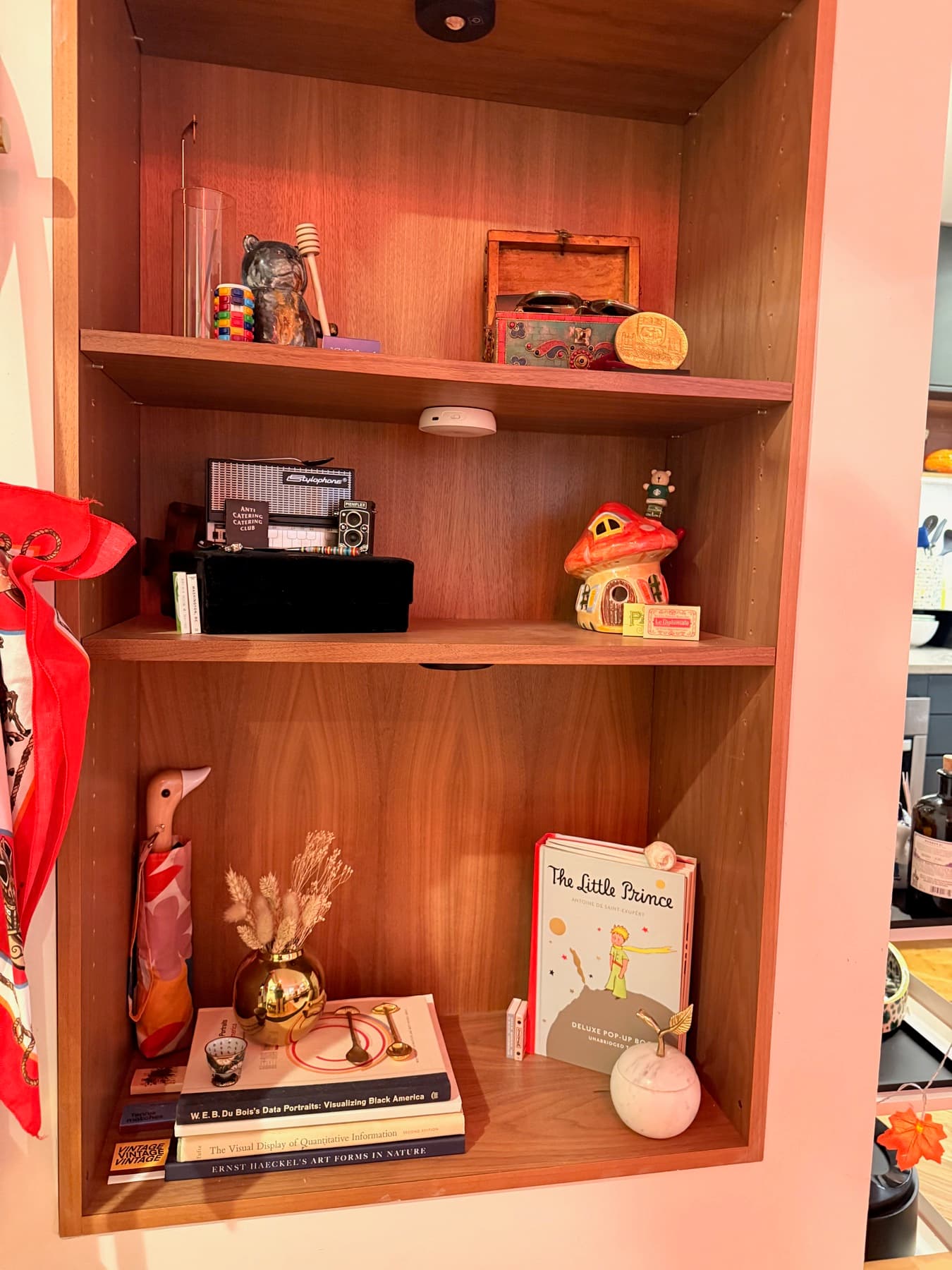
The library
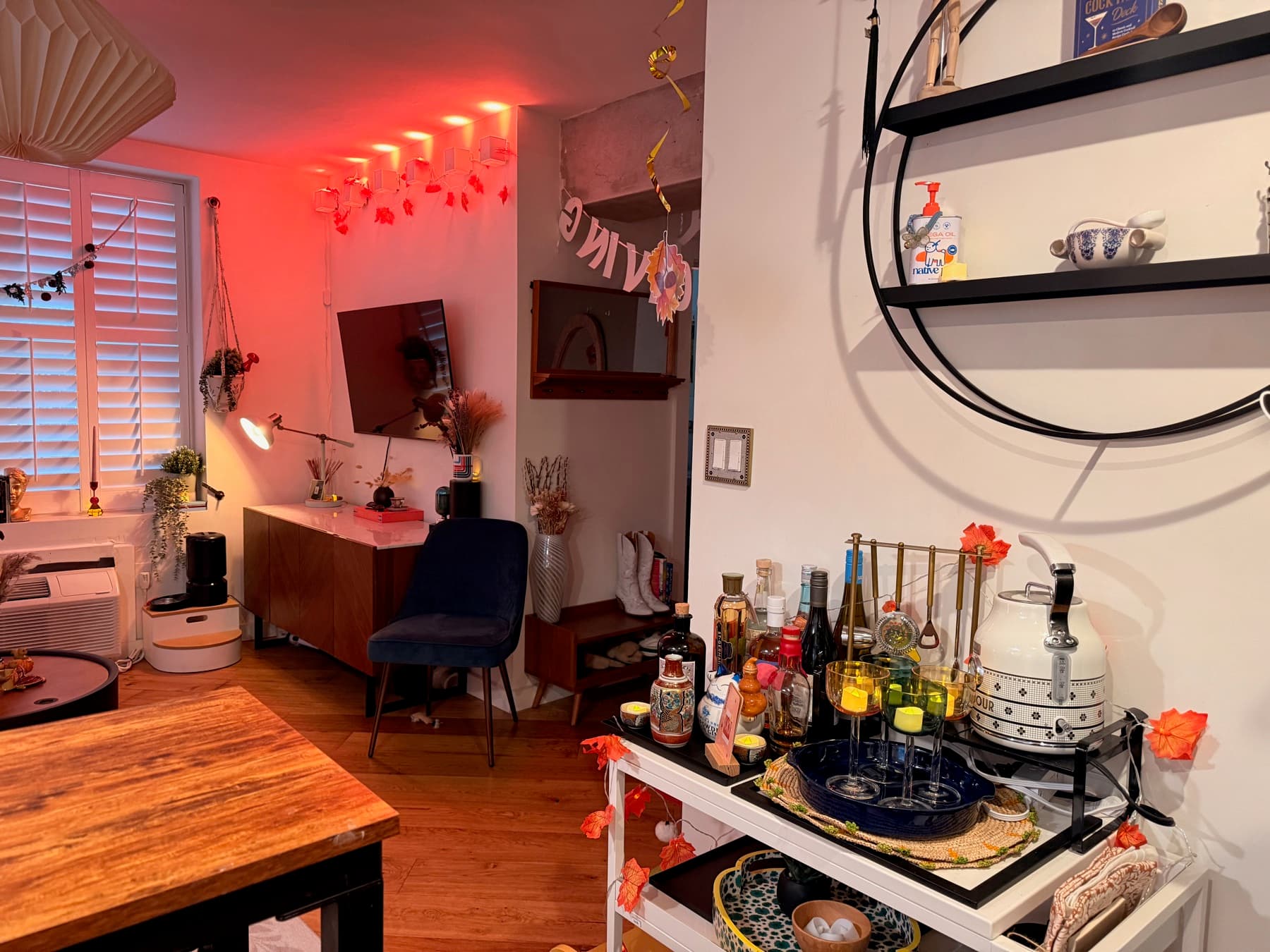
Harmony in red
The room at night, in its own red.
Around the Large Glass
Sixteen minutes after Matisse, a different gallery. The wall says: AROUND THE LARGE GLASS.
MoMA · Duchamp Gallery
“Immediately I wanted to change. The idea was to change; not to repeat myself.”
Marcel Duchamp
The Bride Stripped Bare by Her Bachelors, Even (The Large Glass), 1915–23. A nine-foot painting on glass, declared “definitively unfinished.” Later its panes shattered in transport. Duchamp meticulously reassembled the broken pieces within a new frame and called it done.
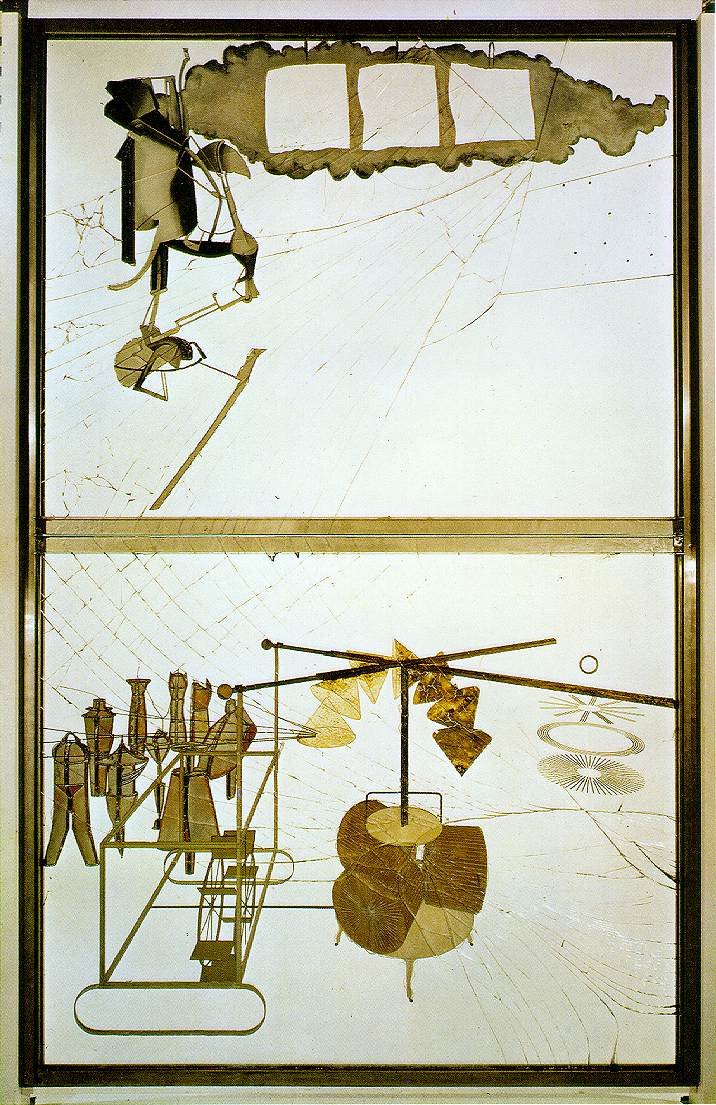
Marcel Duchamp, The Bride Stripped Bare by Her Bachelors, Even (The Large Glass), 1915–23
The Louise and Walter Arensberg Collection · public domain · Philadelphia Museum of Art
The readymades gallery is around the corner. The wall label there begins with the axiom: “The choice of readymades is always based on visual indifference and, at the same time, on the total absence of good or bad taste.” Fountain, 1917, submitted under R. Mutt, rejected, later lost, known only from photographs and replicas.
Matisse insisted on craft. Duchamp insisted on choice. One made beauty non-negotiable; the other made beauty irrelevant. Both of them were saying the same thing underneath: the artist decides what the room is. That authority is the work.
Philosophers as Rooms
My mind does not work in a straight line. It connects all the ideas, the books, the rooms. There is no single point. It is everything.
The Foundation
Spinoza
The Laboratory
Hume
The Threshold Run
Camus
The Workshop
Hegel
The Will
Nietzsche
The Leap
Kierkegaard
The Devotional Tradition
The Sanskrit books are one of the origin objects. They sit on the shelf between Haeckel’s drawings and the apartment I built. In the longer essay on devotion, I traced how the Bhakti poets arrived at the same position Matisse did: the divine does not live in the temple. It lives in the person who decides to seek it. No priest, no Sanskrit, no gate.
“The rich will make temples for Shiva. What shall I, a poor man, do? My legs are pillars, the body the shrine, the head a cupola of gold.”
Basavanna · trans. A. K. Ramanujan, Speaking of Siva (1973)
“I love the Handsome One: he has no death, decay, nor form; no place or side; no end nor birthmarks. I love the Beautiful One with no bond nor fear, no clan, no land, no landmarks for his beauty.”
Akka Mahadevi · trans. A. K. Ramanujan, Speaking of Siva (1973)
“Why do you go to the forest in search of the Divine? He lives in all and is yet ever distinct; He abides with you, too. As fragrance dwells in a flower, or reflection in a mirror, so the Divine dwells inside everything. Seek Him therefore in your heart.”
Guru Tegh Bahadur · in Eating God, ed. Arundhathi Subramaniam (Penguin India, 2014)
This is the thing I keep circling: people have been saying the same thing, same story, different font, for centuries since we started. Sanskrit literally.
In my own words
You know why poetry is so beautiful, because I put it all together. People have been saying the same thing, same story, different font for centuries since we started. Sanskrit literally. And you know why? Because whereas all of the great philosophy books, you think you have to read them, you have to read hundreds of pages. But when you get down to it, poems and the ability to collapse an entire belief system. The Bhagavad Gita collapsing everything into just poems because you don’t need the words when you feel the words.
The Gita says: you have the right to work, but never to the fruit of work. Nishkama karma. The Bhakti poets say: the temple is your body and the divine is already inside it. Matisse says: the room will be red because red is what the room needs. These are not three ideas. Same argument, different century.
What If He Was Happy
Camus said you must imagine Sisyphus happy. I do not imagine it. I run it. Mile six of a lactate threshold workout, heart rate at 172, legs asking to stop, and I ask myself: what if he was happy pushing the boulder?
Not happy in a naive way. Not happy because the suffering is not real. Happy because the capacity to push is the point. Revision seventeen of the deck, the system breaking at midnight, the build that will not compile. Joy is downstream of all of it, and the only question is whether you know that.
In my own words
I want to build meaning into it because that is the work, and that is how you stay happy. I always wanted to be an existentialist and a nihilist until I realized it is in direct opposition to who I actually really want to be and what is worthy of actually building, which is not negativity. It is everything to do with joy because it is infectious, and I am an infectious joyful happy person. I see how it lights people up, and I see how it lights me up.
Taking It All Down
September. Chicago. A new apartment that does not exist yet. The room I built in DC, the museum of memories, is coming off the walls. Every shelf, every carefully placed object, every decision about what kind of life I believed I deserved: into boxes.
Duchamp declared The Large Glass definitively unfinished. Then it shattered. Then he assembled the broken pieces within a new frame and kept going. That was the final form.
I am not losing a room. I am doing what Matisse did: repainting the room because it has to change. Blue to red. DC to Chicago. The will is the same will.
The throughline
The imperative
Creation is bringing something into this universe that did not exist through your own thought being so sure of that thought.
And I have never been sure of anything, but I am so sure of that.
Origin Objects
Haeckel’s drawings
MBL
The Sanskrit books
India
Therapy
DC
The apartment
DC
Continues in
On Love
Complete with a museum of memories: adventures, laughing, being present.
The museum →On Ambition
The ambition is real and it runs through the work, not through what the work gets me.
The work →Something to Say
Matisse, Duchamp, Rothko, Dali, and the Washington Color School. The artists who were arguing about what art is for.
The artists →Devotion & Poetry
The Gita, the Bhakti poets, and the seven thinkers who said the same thing across two millennia.
The tradition →