A weekend along Lake Superior
The race on my Michigan calendar was the Marquette Half Marathon, September 5, 2026, starting in Negaunee. My trip with Jeannette also brought me to Miners Beach, with Miners Falls and Sand Point in our evening plans and kayaking the following morning. The useful souvenir is a guide I wanted on the water: upper hand, lower hand, rotation, and why paddling should involve more than exhausted arms. [1]
| Place / event | What I have recorded |
|---|---|
| Marquette Half Marathon | Race entry confirmed; finish time and race reflections still to add. |
| Miners Beach | Visited. The beach stop was already done when we discussed the evening. |
| Miners Falls → Sand Point | Evening arrival plans recorded; keeping them separate from a completed travel log. |
| Kayaking | Next-morning plan recorded; exact outfitter and route still to add. |
Trip details come from my September trip notes. The race organizer verifies the event, not my personal result. This is an evolving field note.
Your torso moves the paddle; your hands connect it
A forward stroke has three parts: plant the blade near your feet, rotate through the stroke, then lift it out around your hip. Fully place the blade in the water before loading it. Long pulls behind your body add work where you have less useful leverage. [2]
Start upright with relaxed shoulders, feet supported, and knees comfortably bent. Hold the shaft with both hands about shoulder-width apart; a rough fitting check is to hold it above your head with elbows around right angles. Keep your wrists fairly straight and your grip light. This is a two-bladed kayak paddle: both hands stay on the shaft. [3]
Figure 1
Follow one forward stroke
right hand: lower, near the working blade. left hand: higher, pressing the shaft forward. Reverse these roles on the next stroke.
1. Catch
Rotate to reach comfortably; immerse the blade before applying force.
2. Drive
The higher hand presses forward while the lower hand guides the blade.
3. Release
Slice out around the hip; reset to plant the opposite blade.
Dots show the working blade relative to feet and hip, not an anatomical drawing or a distance scale. “Upper” and “lower” describe temporary hand roles; both hands keep an overhand grip on the shaft. Technique: REI’s stroke guide.
The higher hand presses the shaft forward as the lower hand guides the working blade alongside the boat. Both hands travel with your rotating torso. Avoid interpreting “push” as an instruction to punch your shoulder forward or lock an elbow. Think of a comfortable frame between chest, arms, and paddle. The hands exchange jobs on the next side. [2] [3]
A connected effort, from footrest to blade
| Region | Job in the stroke |
|---|---|
| Obliques and abdominal wall | Help coordinate trunk rotation and control the torso under paddle load. |
| Latissimus dorsi / back | Contribute to transmitting force through the working shoulder and arm. |
| Shoulder girdle and arms | Position, support, and guide the paddle; the arms participate without doing all the work. |
| Legs and trunk | Footrest contact and leg action help connect the body to the boat. Forceful sprint-style leg drive is not a beginner requirement. |
On-water sprint research has measured abdominal activity and trunk motion; related work has studied back and leg activation. These studies support the whole-body picture. They do not establish a universal percentage of work for each muscle, or prove that more rotation always means a better recreational stroke. [4] [5]
My cue to remember: plant, rotate, release. If the grip keeps tightening or the shoulders keep rising, slow down and reset. This is a technique cue, not a diagnosis of soreness.
Forward is only one direction
- Turn: a wide forward sweep on the right helps turn the bow left; a left sweep helps turn it right. A sweep traces a broader arc than a forward stroke.
- Stop: use controlled reverse strokes, placing the blade near the hip and working toward the feet. Check behind you before travelling backward.
- Move sideways: a draw brings water toward the side of the boat. Get an instructor to demonstrate blade exit so the paddle does not catch against the hull.
Practice in sheltered water before adding wind, waves, or a shoreline with limited exits. [2]
The lake decides whether the lesson happens
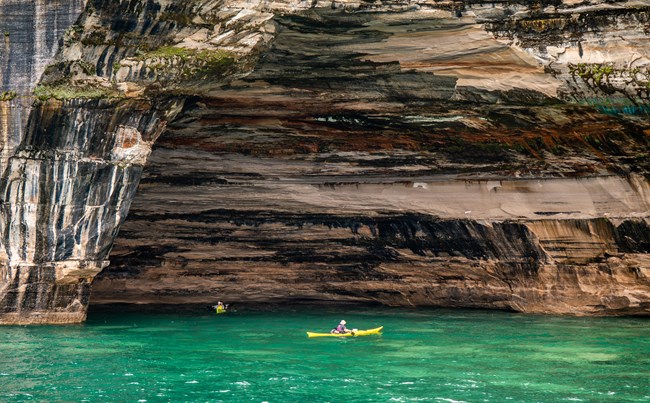
Pictured Rocks is exposed Lake Superior paddling. NPS recommends experienced sea kayakers or a guided trip along the cliffs, and sea kayaks suitable for that environment. A recreational kayak and a short technique guide are not preparation for an unguided cliff trip. [6]
Wear a properly fitted life jacket, dress for cold-water immersion, check the marine forecast, and follow the guide’s cancellation decision. Cliffs limit landing options; wind and waves can change conditions quickly. A beautiful view does not make cold water forgiving. [6]
That is the part I want to keep with the travel memory: learning a landscape includes learning what it asks of your body, and when to stay on shore.
Sources & further reading
- Race organizer: 2026 Marquette Half Marathon
- REI: forward, reverse, sweep, and draw strokes
- REI: getting started kayaking
- Brown et al.: trunk rotation and abdominal activity in sprint kayaking
- Brown et al.: trunk and leg muscle activation
- National Park Service: kayaking at Pictured Rocks
Technique is synthesized from instruction sources; the muscle discussion distinguishes sprint research from recreational guidance. Last researched September 7, 2026.