SOSC 19018 · Fall 2019
India before Europe: Histories of Place
Mannat Johal, University of Chicago
Three weeks across southern India with the University of Chicago, reading Pollock and Davis on the road, visiting every site the syllabus assigned. The course asked one question at every stop: what happens to a place when centuries of use, worship, looting, and restoration pile up on the same stones?
The route
Round markers are the Deccan course, colored by tradition (see the key under Deep time, below); tap one for its dates. The course was a tight southern loop. Tap Whole trip to zoom out to the full subcontinent and the six diamond markers of the wider journey, from Mumbai to Delhi to the Himalaya.
Beyond the Deccan
The academic course was a tight loop through the Deccan. The trip around it reached the rest of the subcontinent: the coast at Mumbai, the Mughal north at Delhi, the Qutb Shahi east at Hyderabad, and the Buddhist Himalaya at Darjeeling and Gangtok. Six places the syllabus never covered.
Mumbai
the coast — twice
The way in and the way back: the Gateway of India and the Parsi-built skyline on arrival, and on a separate tour the urban form of the city — Dharavi and the kind of settlement Katherine Boo's Behind the Beautiful Forevers is set in.
Elephanta Caves
an island in Mumbai harbour
Rock-cut Shaiva caves, c. 5th–7th century, an hour's ferry off the coast — crowned by the colossal three-headed Trimurti Sadashiva: Shiva as creator, preserver, and destroyer in one sculpture.
Delhi
the capital, far north
Eight cities on one plain: the 12th-century Qutb complex (the first Islamic monuments in India), Humayun's Tomb (the prototype the Taj refined), and Shah Jahan's Red Fort and Jama Masjid. The Mughal heart the Deccan course never reached.
The Mughals deep-dive →Hyderabad
the eastern Deccan
The Qutb Shahi capital: Golconda Fort on its granite hill, the Charminar (1591) at the city's crossing, and the domed Qutb Shahi tombs — the last Deccan Sultanate the Mughals annexed, in 1687. Where Bijapur's story ends.
The Mughals deep-dive →Darjeeling
the eastern Himalaya
The British hill station and the 'champagne of teas' — terraced gardens on impossibly steep slopes, the UNESCO 'toy train,' and Kanchenjunga, the world's third-highest mountain, filling the horizon at dawn.
The Himalaya deep-dive →Gangtok
Sikkim, in the Himalaya
Capital of Sikkim — a Buddhist Himalayan kingdom that stayed sovereign until 1975. Tibetan monasteries (Rumtek, a seat of the Karmapa), prayer flags along the ridges, an India with almost nothing in common with the Hindu-Islamic south.
The Himalaya deep-dive →Deep time
The same journey, plotted by date instead of place: 800 BCE to 1905 CE. A single stop can hold millennia: at Hampi, Iron Age dolmens sit on the same ground as a 16th-century imperial capital. Tap any era to jump to its stop.
The eras, and what each is known for
Seven traditions crossed in three weeks, from the 6th-century Chalukya laboratory to a 1900s Indo-Saracenic palace. Each opens into a deep dive on the architecture, the art, and what it argued.
The laboratory of the temple: Aihole, Pattadakal, Badami, where Nagara met Dravidian.
Read →Renunciation in stone: the 57-foot Bahubali at Sravanabelgola, standing since 981 CE.
Read →Codified grammar in soapstone: the star-plan jewel-box at Somnathpur, signed by its sculptor.
Read →Architecture as imperial power: a temple-city at Hampi among the largest on earth.
Read →The dome and the whisper: Bijapur’s Gol Gumbaz and the Indo-Islamic synthesis.
Read →The hybrid as a deliberate design choice: the Mysore Palace’s composite facade.
Read →The seam where India meets Europe: Old Goa’s Baroque churches, built by Indian hands.
Read →Stops
Pune
Maharashtra · Nov 17 · 1 day
The course began in Pune with foundational lectures. Pollock’s thesis — that Sanskrit was not merely a sacred language but a political technology, a ‘cosmopolitan vernacular’ wielded by courts across South and Southeast Asia — reframed every site visit that followed. Davis’s Lives of Indian Images introduced the idea that sculptures and temple images have biographies: they are born, consecrated, worshipped, looted, collected, and displayed. Their meaning changes with each context. These two frameworks — language as power, images as living things — became the lens for the entire journey.
What the reading argued
Sanskrit wasn’t only sacred — it was a political technology, a cosmopolitan code courts from Java to Kashmir used to project power.
Temple images have biographies — born, consecrated, worshipped, looted, collected, displayed. The meaning changes with every room the object enters.
Mysore
Karnataka · Nov 17–21 · 5 days · 169 photos
Mysore was the longest stop and the most layered. The Wodeyar palace is pure spectacle — Indo-Saracenic excess designed to project princely authority in a colonial age. But Nair’s reading cuts deeper: the entire city is a museum of itself, a princely state that made self-display into governance. At Somnathpur, the Hoysala temple’s star-shaped plan and continuous sculptural frieze demonstrate what Hardy calls a ‘codified grammar’ — the architectural vocabulary was so established that the art lay in variation, not invention. Each panel of elephants, horsemen, and epic scenes follows rules, but no two are identical. At Srirangapattinam, Brittlebank’s ‘experience rather than event’ framework asks visitors to see the fortress not as the static backdrop to Tipu Sultan’s last stand, but as a living palimpsest where Hindu, Muslim, and British layers continuously resignify the same stones.
What the reading argued
The princely city is a museum of itself; the Wodeyars turned self-display into a technique of governance.
Hoysala design ran on a codified grammar — the art lay in variation within the rules, not invention against them.
Read the fort as experience, not event: a palimpsest where Hindu, Muslim, and British layers keep resignifying the same stones.
Mysore Palace
Indo-SaracenicIndo-Saracenic Revival · Wodeyar · 1897–1912
The current palace replaced one destroyed by fire during a wedding in 1897. The Wadiyar dynasty ruled Mysore as a princely state under British suzerainty from 1399. British architect Henry Irwin designed the replacement in the Indo-Saracenic style — a hybrid Victorian idiom that borrowed freely from Mughal, Rajput, and Dravidian vocabularies. During Dasara, the palace is illuminated by 97,000 lightbulbs.
- Three-story granite structure with pink marble domes
- Cast-iron frame and load-bearing masonry (designed by Henry Irwin)
- Kalyana Mantapa (marriage pavilion): octagonal, stained-glass peacock ceiling, cast-iron pillars with floral capitals
- Durbar Hall: 4,000 sq ft, painted ceiling, carved silver doors, raised platform for the golden throne
- Blend of Hindu (temple gopurams), Islamic (domes, arches), and Gothic (clock tower) elements into a single facade
Somnathpur (Keshava Temple)
HinduHoysala stellate · Hoysala · 1268 CE
Consecrated in 1268 CE under the Hoysala king Narasimha III and endowed by his general Somanatha, after whom the surrounding Brahmin settlement of Somanathapura is named. It is the last great Hoysala temple, finished just before the dynasty fell to the Delhi Sultanate’s southern campaigns. Its main images were desecrated in those invasions, so it is no longer an active temple — which is exactly why its sculpture survives so completely as a museum of Hoysala craft. Adam Hardy, assigned for this stop, uses Somnathpur to argue that Hoysala design ran on a ‘codified grammar’: the forms were so rule-bound that the art lay in variation within the system, not invention against it.
- Trikuta (three-shrine) plan: three star-shaped sanctums share one pillared hall, each built for a form of Krishna — Keshava, Janardana, Venugopala
- Raised stellate platform that the visitor walks around; the zig-zag star plan multiplies the wall surface available for sculpture
- Carved in soft soapstone (chloritic schist) that hardens with exposure, allowing lathe-turned pillars and jewel-fine miniature detail
- Continuous base friezes wrap the whole temple: rows of elephants (stability), then horsemen (speed), scrollwork, hamsa geese, and narrative bands from the Ramayana, Mahabharata, and Bhagavata
- Stepped vimana towers over each shrine are miniature replicas of the whole building — the stellate plan stacked into itself
- Panels signed by the sculptor Mallitamma — one of the very few named medieval Indian artists
Srirangapattinam
Indo-IslamicIndo-Islamic painted palace · Mysore Sultanate · 15th–18th century
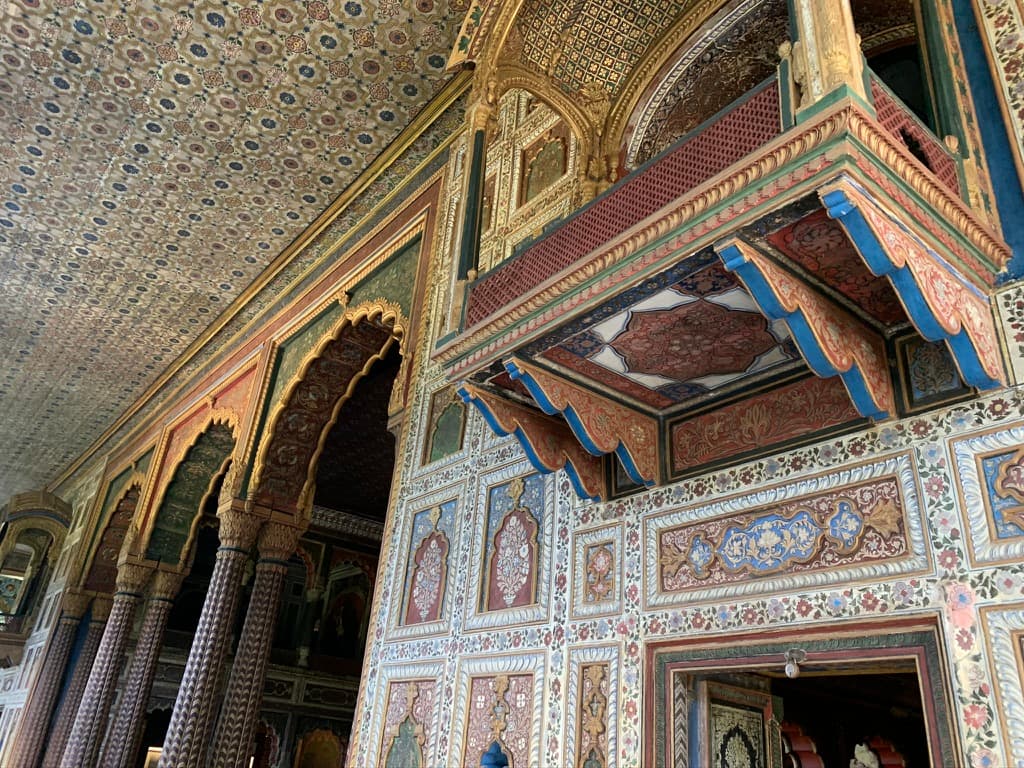
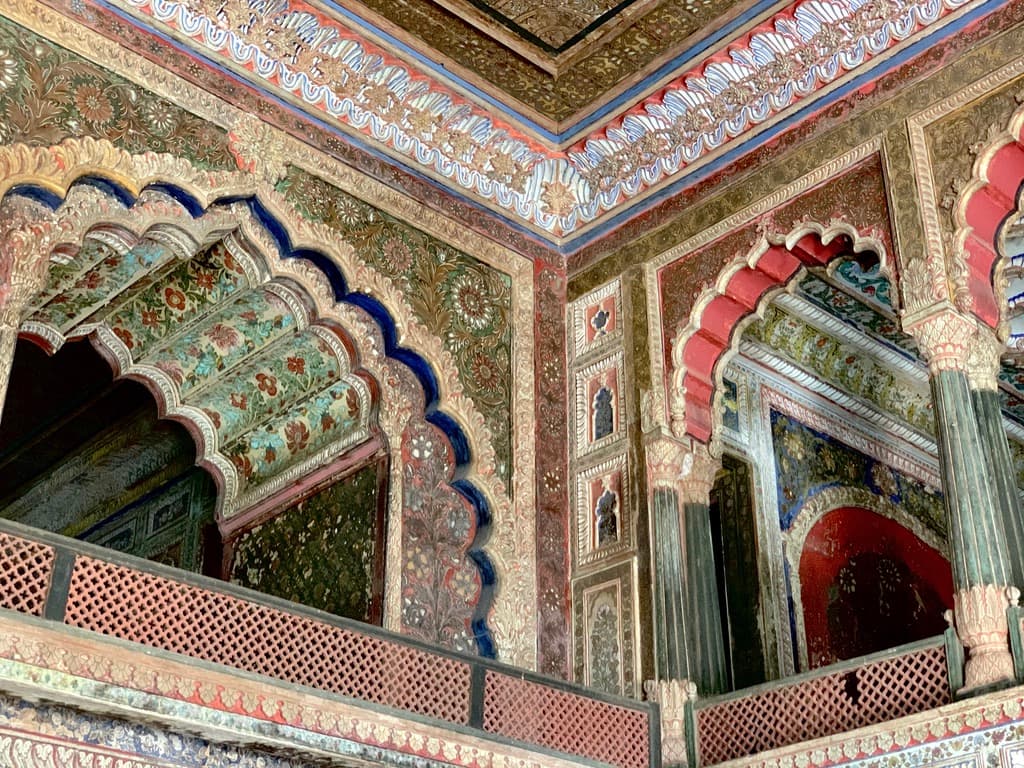
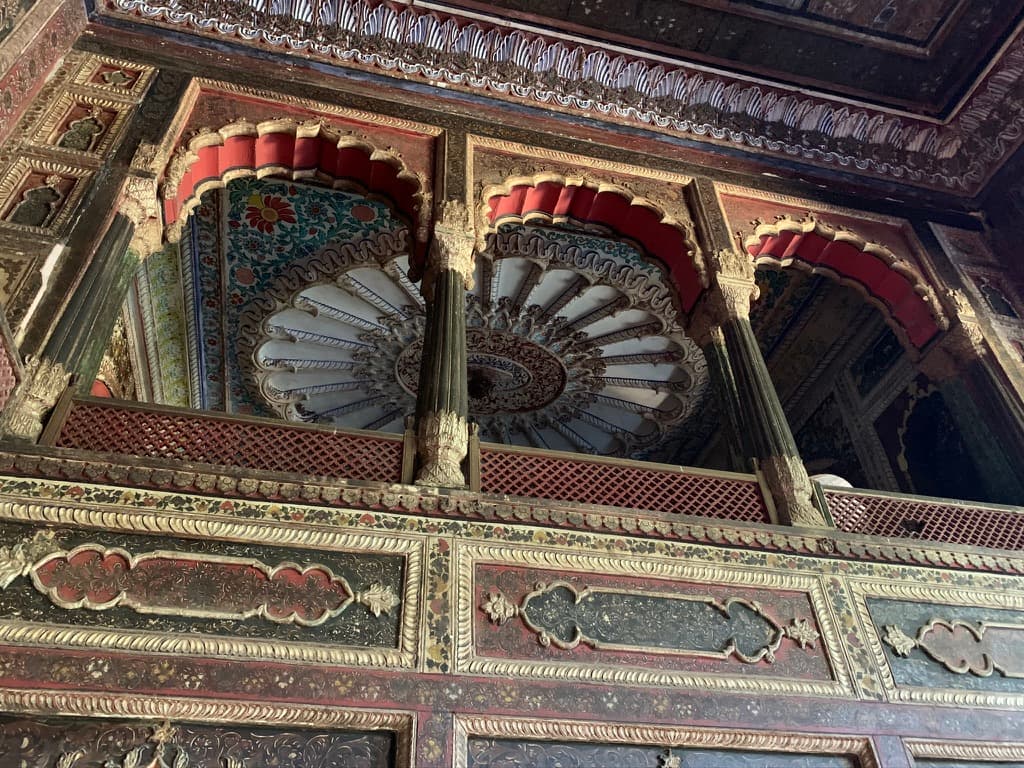
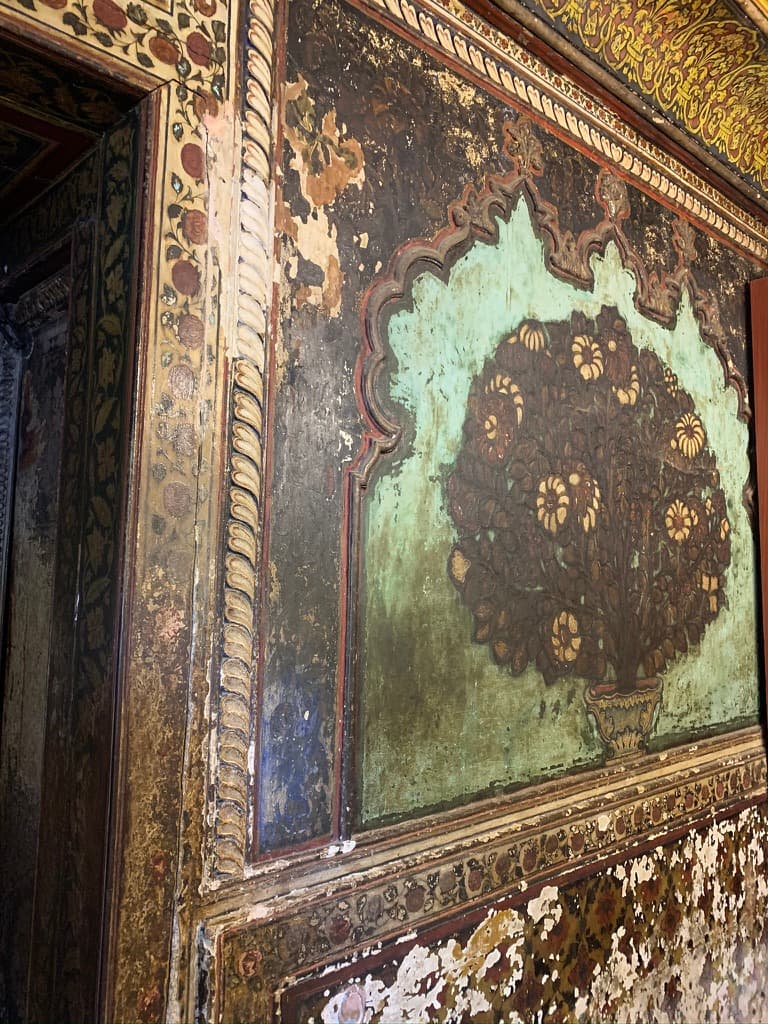
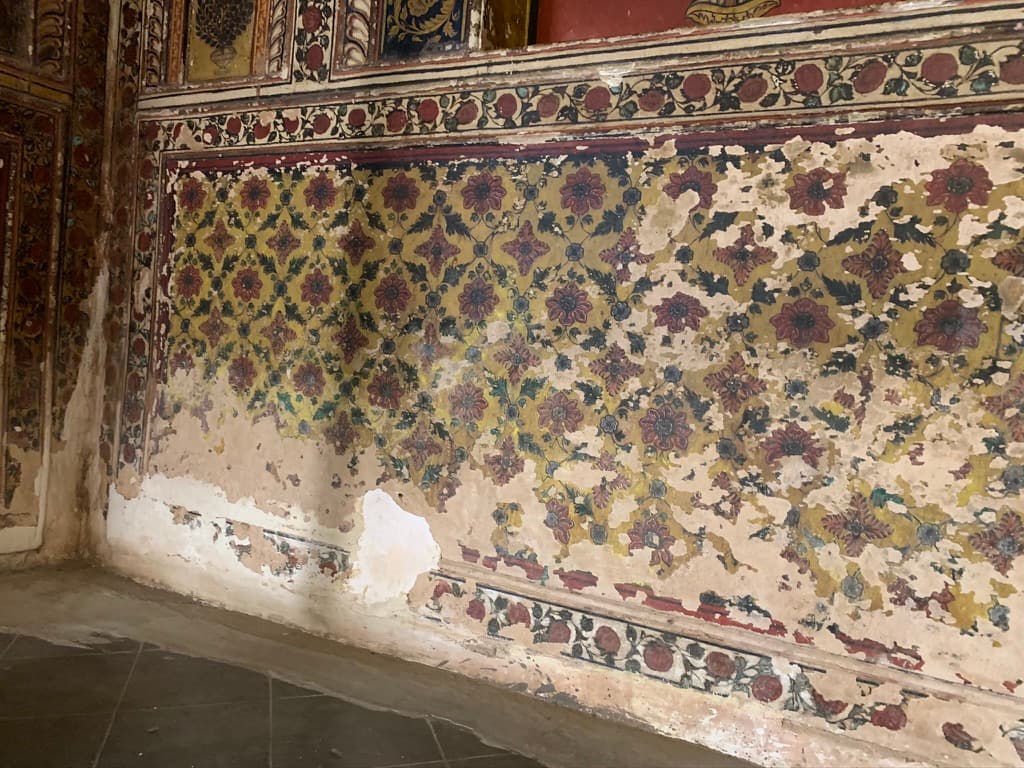
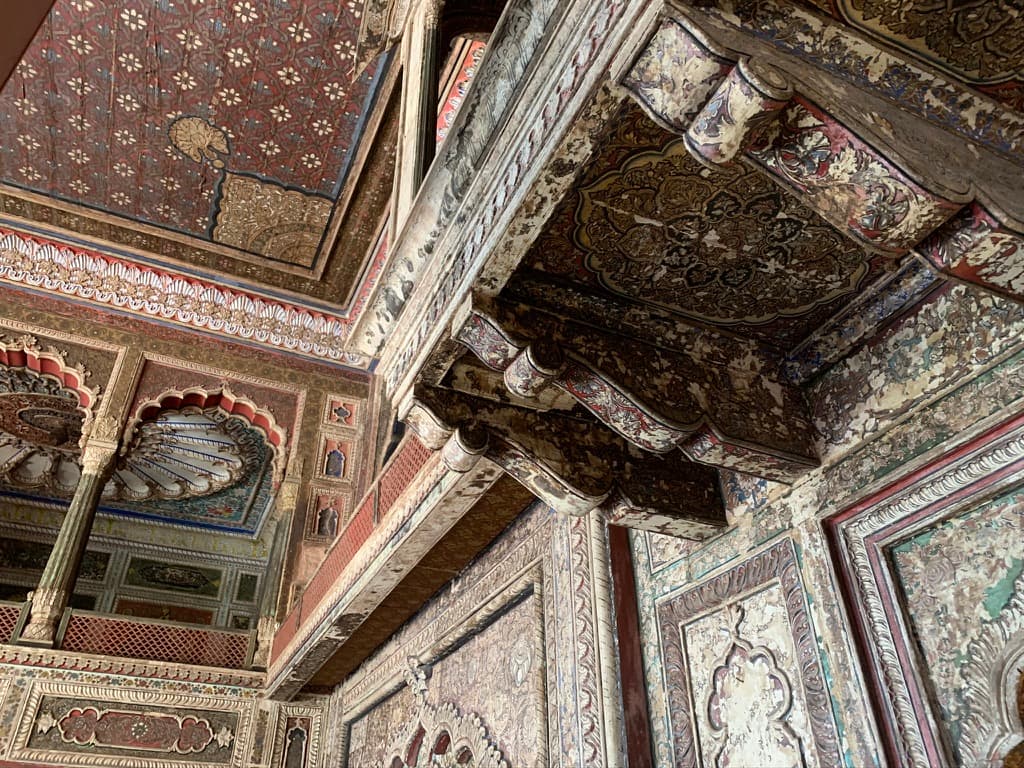
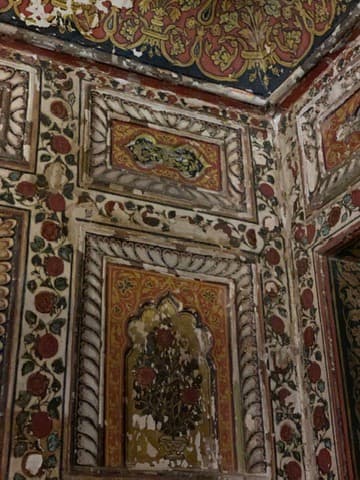
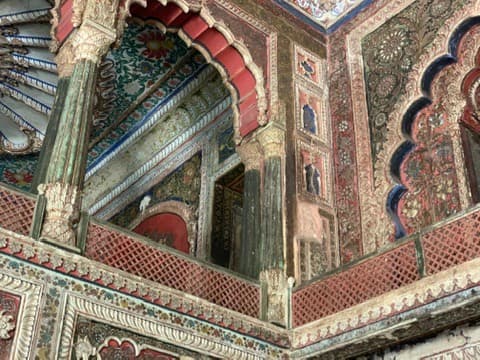
Srirangapattinam was the island capital of Tipu Sultan, the ‘Tiger of Mysore,’ who died here in 1799 when the British stormed the fort — the moment that ended the Anglo-Mysore wars and opened South India to Company rule. His painted summer palace, its teak halls frescoed floor to ceiling, survives as one of the finest Indo-Islamic interiors in the south. Kate Brittlebank, assigned for this stop, reframes the site as ‘experience rather than event’: not just ‘where Tipu fell’ but a palimpsest where Hindu, Muslim, and British layers keep resignifying the same stones.
- Teak-columned halls under polylobed (scalloped) arches — an Indo-Islamic idiom fusing Mughal and Deccan forms
- Walls and ceilings covered edge to edge in floral fresco and gilt, almost no surface left plain
- Painted medallions, niches, and narrative panels in red, green, and gold
- Two centuries of wear in the faded plaster — the palimpsest the course kept returning to
Sravanabelgola
Karnataka · Nov 22 · 1 day · 56 photos
No reading was assigned for Sravanabelgola. This was pure encounter — 614 steps up Vindhyagiri Hill to face a 57-foot naked figure carved from a single block of granite over a thousand years ago. Bahubali stands in kayotsarga, the Jain posture of complete renunciation. Vines grow up his legs and arms; anthills form at his feet. The statue’s power is its scale and its patience — it has stood in that posture since 981 CE, indifferent to weather, dynasties, and tourists. Every twelve years, the Mahamastakabhisheka ceremony pours thousands of pots of milk, saffron, and sandalwood paste over the monolith’s head. The most recent was 2018, one year before our visit.
What the reading argued
The one stop the syllabus left to the body — 614 steps to a 57-foot monolith that has held a single posture since 981 CE.
Gommateshvara (Bahubali)
JainJain monolithic sculpture · 981 CE
Commissioned by Chavundaraya, a minister and military commander of the Western Ganga dynasty, in 981 CE. Bahubali (also called Gomateshvara) was the son of the first Jain Tirthankara, Adinatha. According to tradition, Bahubali won a battle against his brother but renounced the kingdom, standing in meditation so long that vines grew up his body. The Mahamastakabhisheka (great head-anointing ceremony) occurs every 12 years: the monolith is doused in milk, saffron paste, sandalwood, and vermillion from scaffolding erected above. The most recent was 2018, one year before Jenn's visit.
- 17.4 meters (57 feet) tall, carved from a single block of granite in situ
- Kayotsarga posture: standing meditation with arms at sides, not touching the body
- Naturalistic detail: vines (vanamala) carved climbing the legs and arms; anthills at the feet
- Originally polished smooth — the granite surface was burnished to reflect light
- Faces north (unusual for Jain images, which typically face south)
- Base platform with carved attendant figures and decorative motifs
Hampi
Karnataka · Nov 23–26 · 4 days · 524 photos
Hampi was the most heavily assigned stop and the emotional center of the trip. Three full days in a boulder field that was once the capital of an empire. Vijayanagara at its peak in the early 16th century was one of the largest cities in the world — larger than Rome, with a sophisticated water infrastructure and temples that doubled as instruments of state power. Wagoner’s papers show how the Sangama dynasty used architecture to assert legitimacy, and how later rulers deliberately retrieved Chalukyan forms to anchor their authority in a longer past. Dallapiccola’s reading reveals the mythological layer: locals and texts identified Hampi’s boulder-strewn landscape as Kishkinda from the Ramayana — the monkey kingdom where Rama enlisted Hanuman. The ruins sit inside a living myth. Eaton’s essay on Rama Raya complicates the Hindu-Muslim binary — Vijayanagara’s last great ruler moved fluidly through Persianized court culture. And the ‘fall’ itself, which textbooks narrate as civilizational catastrophe, was, per Lycett and Morrison, a gradual transformation rather than a single apocalyptic battle. At Hire Benakal, Bauer’s paper rewinds the clock further — Iron Age megalithic burials prove that humans were ‘producing’ this political landscape millennia before any empire claimed it.
What the reading argued
The Sangama kings built legitimacy in stone, deliberately retrieving older Chalukya forms to anchor their rule in a deeper past.
Texts and locals read Hampi’s boulder field as Kishkinda from the Ramayana — the ruins sit inside a living myth.
Vijayanagara’s last great ruler moved fluidly through Persianate court culture — the tidy Hindu/Muslim binary dissolves.
The ‘fall’ textbooks narrate as catastrophe was a slow transformation, not one apocalyptic battle.
Vijayanagara Ruins
HinduVijayanagara (composite Dravidian) · Vijayanagara / Sangama · 14th–16th century
Vijayanagara (‘city of victory’) was founded in 1336 by the Sangama brothers Harihara and Bukka, and at its 16th-century peak under Krishnadevaraya it was among the largest cities on earth, ringed by walls and fed by a canal-and-tank system that still works in places. Philip Wagoner, assigned here, shows how the early kings used architecture — and the deliberate retrieval of older Chalukya forms — to manufacture legitimacy, while their court dress and secular buildings borrowed freely from the Islamic Deccan. The city was sacked in 1565 after the battle of Talikota; Lycett and Morrison argue the ‘fall’ was a slow transformation, not a single apocalypse. The name itself carries Morrison’s ‘politics of time’: called Vijayanagara it reads as a Hindu imperial capital, called Hampi it reads as a UNESCO landscape.
- Towering brick-and-stucco gopurams over stone bases — the Virupaksha temple’s eastern gateway rises about 50m and is still in daily worship
- Vitthala temple complex: the famous stone chariot (a Garuda shrine carved as a temple car) and the SaLE ‘musical’ pillars that ring when struck
- Composite yali piers — monolithic granite pillars carved with rearing leogryphs and riders, the signature Vijayanagara order
- Secular buildings in an Indo-Islamic idiom: the Lotus Mahal and Elephant Stables use arches and domes borrowed from the Deccan sultanate courts
- A planned imperial city of platforms, tanks, and aqueducts — the Mahanavami Dibba ceremonial platform anchors a royal centre kept apart from the sacred temple precincts
- Set in a granite boulder landscape identified with Kishkindha, the monkey kingdom of the Ramayana — myth and masonry on the same ground
Bijapur (Vijayapura)
Karnataka · Nov 27 · 1 day · 129 photos
Bijapur was the seat of the Adil Shahi sultanate — the Islamic counterpart to Vijayanagara’s Hindu court, though Eaton’s work (read at Hampi) already complicated that binary. Kasdorf’s paper on ‘translating sacred space’ traces how Bijapur’s builders adapted Hindu architectural grammar into Islamic forms, producing hybrid buildings that belong to neither tradition cleanly. The Gol Gumbaz’s dome is almost absurdly large — about 44 meters across on the outside, among the largest pre-modern masonry domes anywhere, though its internal span is smaller than the Pantheon’s or St Peter’s. But the whispering gallery at the top, where a whisper carries across the entire vault, is the detail that sticks. Ibrahim Rauza, the delicate tomb-mosque built shortly before the Taj Mahal and often compared to it, offers the opposite register: intimate, calligraphic, exquisitely carved.
What the reading argued
Hindu structural craft and Islamic form fuse into buildings that belong cleanly to neither tradition.
Gol Gumbaz
Indo-IslamicDeccan Sultanate / Indo-Islamic · Adil Shahi Sultanate · 1656
Gol Gumbaz is the mausoleum of Mohammed Adil Shah (r. 1627–1656), seventh sultan of the Adil Shahi dynasty of Bijapur, left unfinished at his death. The Adil Shahis were a Deccan sultanate — Persianate in court culture and frequently at war with both Hindu Vijayanagara to the south and the Mughals to the north, who finally annexed Bijapur in 1686. Katherine Kasdorf, assigned for this stop, reads Bijapur’s monuments as ‘translations’ of sacred space, where Hindu structural craft and Islamic form fuse into buildings that belong cleanly to neither. The architect, Yaqut of Dabul, spanned an enormous square hall without a single internal pillar; the whispering gallery has since made it one of India’s most visited acoustic curiosities.
- Single hemispherical dome about 44m across — among the largest masonry domes built anywhere before the modern era, and the largest in India by external span
- The dome rests on eight intersecting arches (squinches), not a drum, turning the square hall into an octagon then a circle with no internal columns
- The Whispering Gallery: a circular walkway inside the dome’s base where a whisper carries clearly across 38m and a single sound echoes up to ten times
- A cube of dark basalt about 47.5m on each side, with a seven-storey octagonal stair-tower at each corner
- Deliberately austere next to Mughal work to the north — mass and acoustics over ornament, Deccan self-assertion in pure geometry
Aihole, Pattadakal, Badami
Karnataka · Nov 28 · 1 day · 112 photos
No reading was assigned — this was Thanksgiving Day, and the group had dinner in Badami after a full day of temple visits. The three sites form a trilogy that tells the story of how South Indian temple architecture was invented. Aihole is the laboratory: over 100 temples built across seven centuries, each testing a different structural idea. Circular plans, apsidal plans, stellate plans — prototypes that would be refined into the great temples of later centuries. Pattadakal is the showcase: a UNESCO World Heritage complex where the Chalukya kings placed Dravidian (southern) and Nagara (northern) style temples side by side, demonstrating their command of both traditions. Badami is the origin: four cave temples carved directly into red sandstone cliffs rising above Agastya Lake. The cliff face is the architecture. Cave 1 (Shiva), Caves 2–3 (Vishnu), Cave 4 (Jain) — a religious pluralism literally carved in stone. Thanksgiving dinner in Badami, thousands of miles from home, watching the sunset turn the cliffs the same red as the temples.
What the reading argued
Thanksgiving Day, no text — three sites that together narrate how the South Indian temple was invented: laboratory, showcase, origin.
Aihole
HinduEarly Chalukya (experimental) · Chalukya · 5th–12th century
Called the 'cradle of Indian architecture' or the 'Cambridge of temple design.' The Early Chalukyas of Badami (543–757 CE) used Aihole as an architectural laboratory, testing structural ideas from both northern (Nagara: curvilinear tower) and southern (Dravidian: stepped pyramid) traditions side by side. The variety of plans in a single village is unmatched anywhere in India. The Meguti Temple's inscription (634 CE) by the poet Ravikirti is one of the earliest dated literary records in Kannada.
- Over 100 temples testing apsidal, circular, rectangular, and stellate ground plans
- Durga Temple: unique apsidal (semi-circular) plan with a peristyle of pillars, resembling a Buddhist chaitya adapted for Hindu worship
- Lad Khan Temple: flat-roofed, possibly a converted assembly hall (sabha mandapa), among the earliest structural temples in the Deccan
- Ravula Phadi cave temple: rock-cut, with some of the finest early Chalukya sculptural panels (dancing Shiva, Varaha)
- Meguti Jain Temple (634 CE): dated by inscription, providing a firm chronological anchor for the complex
Pattadakal
HinduChalukya (mature Dravidian + Nagara) · Chalukya · 7th–8th century
The coronation site (pattada = anointing, kal = stone) of Chalukya kings. The Virupaksha Temple was commissioned by Queen Lokamahadevi to celebrate King Vikramaditya II's victory over the Pallavas of Kanchipuram in 740 CE. She brought Pallava artists back to build a Chalukya temple with Pallava craftsmanship — a trophy building that appropriated the conquered dynasty's own artistic tradition. UNESCO World Heritage since 1987.
- Virupaksha Temple (Dravidian): stepped pyramidal vimana, pillared mandapa with Ramayana and Mahabharata narrative panels, Nandi pavilion
- Papanatha Temple (Nagara): curvilinear shikhara tower over the sanctum, northern-style rectilinear plan
- Sangameshvara Temple: earliest of the group, transitional between experimental Aihole and mature Pattadakal
- Side-by-side placement of Dravidian and Nagara styles as a conscious statement of the dynasty's command of both architectural traditions
- Stone sculpture of exceptional quality: bracket figures, ceiling panels, doorframe carvings with mithunas (amorous couples)
Badami Cave Temples
HinduEarly Chalukya rock-cut · Chalukya · 6th century
Badami (ancient Vatapi) was the capital of the Early Chalukya dynasty (543–757 CE) founded by Pulakeshin I. Cave 3's dedicatory inscription dates it to Shaka 500 (578 CE), making it one of the few firmly dated monuments of the early medieval Deccan. The caves face Agastya Lake, named for the Vedic sage — a deliberate cosmological orientation. The cliff's red sandstone gives Badami its distinctive warm palette. The four caves represent three religions (Shaivism, Vaishnavism, Jainism) side by side, carved by the same dynasty in the same century.
- Cave 1 (Shiva): 18-armed Nataraja (cosmic dance) on the entrance veranda, among the earliest surviving representations
- Cave 2 (Vishnu): Vishnu as Trivikrama (the three strides that measured the universe), ceiling panels with Brahma riding a swan
- Cave 3 (Vishnu): largest cave, dated by inscription to 578 CE — the firmest date in early Chalukya art; 16-armed Vishnu, ceiling murals
- Cave 4 (Jain): seated Mahavira with attendant Tirthankaras, demonstrating religious pluralism in a single complex
- Carved directly into living red sandstone cliffs: the cliff face IS the facade, not a decorative addition
- Pillared verandas with bracket figures and pot-and-foliage capitals typical of the Chalukya period
Goa
Goa · Nov 29–Dec 1 · 3 days · 44 photos
The course was titled ‘India before Europe,’ and Goa is where that title becomes ironic. Portuguese India — four and a half centuries of colonial presence compressed into baroque churches, Latin Quarter streets, and a cuisine that fuses vindaloo (from vinha d’alhos) with local fish curries. Pearson’s ‘Indo-Portuguese Society’ traces the hybridization that occurred on both sides of the colonial encounter. The Basilica of Bom Jesus holds the remains of St. Francis Xavier; the Se Cathedral was built to celebrate the Portuguese victory over a Muslim ruler. These are not Indian monuments adapted by Europeans, nor European buildings planted in India — they are something genuinely in between. After two weeks of precolonial sites, ending in Goa was a deliberate provocation: every ‘pure’ tradition we’d studied was already a hybridization. Purity was the myth; translation was the constant.
What the reading argued
The colonial encounter hybridized both sides. Ending ‘India before Europe’ in front of Baroque churches built by Indian hands is the irony the syllabus was built around.
Old Goa Churches
Portuguese CatholicPortuguese Baroque (Manueline traces) · 16th–17th century
Old Goa (Velha Goa) was the capital of Portuguese India and, in the 16th–17th centuries, a city Europeans called the ‘Rome of the East,’ rivalling Lisbon before malaria and the silting of the Mandovi emptied it. The churches are UNESCO World Heritage and mark the eastern edge of the Counter-Reformation: the Basilica of Bom Jesus holds St Francis Xavier, co-founder of the Jesuits, displayed once a decade. M.N. Pearson’s ‘Indo-Portuguese Society,’ assigned here, traces the two-way hybridization of the colonial encounter. Ending a course titled ‘India before Europe’ in front of Baroque facades built by Indian hands is the irony Mannat Johal designed into the syllabus — every ‘pure’ tradition studied over three weeks turned out to be a translation, and Goa makes the seam visible.
- Basilica of Bom Jesus (consecrated 1605): an exposed laterite-and-lime Baroque facade holding the relics of St Francis Xavier in a Florentine silver-and-marble casket
- Sé Cathedral: the largest church in Asia, a barrel-vaulted Portuguese-Manueline nave and the surviving ‘Golden Bell’ prized for its tone
- Church of St Cajetan modelled on St Peter’s in Rome — a Corinthian Baroque dome transplanted to the Konkan coast
- Whitewashed lime plaster over local laterite stone: European liturgical plans built in Indian materials by Indian masons
- Plain outer walls hiding gilded, polychrome Baroque retables inside — twisting Solomonic columns, saints, and gold leaf
Pune (Return)
Maharashtra · Dec 2–6 · 5 days
Back in Pune for the final week. Morrison’s ‘On Putting Time in Its Place’ was the capstone reading — a meta-critique of how archaeologists and historians impose temporal frameworks on South Indian sites. The ‘politics of time’ isn’t just academic: which period gets emphasized at a given site determines who ‘owns’ its history. A site called ‘Vijayanagara’ is Hindu; the same ruins called ‘Hampi’ are a UNESCO landscape. The paper asked us to reconsider every site visit through this lens. The final paper was due December 6. Prompts were provided on December 2, with seminars on the 3rd and 4th to discuss major themes. Individual office hours ran through the 5th.
What the reading argued
The politics of time: which era a site is named for decides who owns its history. Called Vijayanagara it reads Hindu; called Hampi it reads UNESCO landscape.
What the syllabus showed us
Every assigned reading, in route order. Tap any lens to jump to the stop where it was read.
The question at every stop
What happens to a place when centuries of use, worship, looting, and restoration pile up on the same stones?
Purity was the myth. Translation was the constant.
Every ‘pure’ tradition the syllabus assigned — Hindu, Jain, Islamic, Portuguese — turned out, on the ground, to be a translation of something else. The reading list set the question at each stop; the stones answered it.
The bookshelf, September 2019
17 books carried to India. Tap any title to read about the author, the argument, and what it meant.
Course Texts
Foundational
Modern India
Devotional
Reference
The throughline
The books, the visits, the temples, the art
The course asked the same question at every stop: what happens to a place when centuries of use, worship, looting, and restoration pile up on the same stones? For three weeks I watched it get answered in granite and laterite and soapstone, and the answer was always some version of the same thing: that nothing here is only one thing.
The seventeen books were not background. They were the lens. Davis taught me to read a sculpture as something with a biography: born, consecrated, worshipped, looted, collected, re-displayed, its meaning rewritten by every set of hands it passes through. Pollock taught me that a language, and by extension a temple, is a technology of power before it is anything sacred. The Ramayana and the Mahabharata were the source code for the friezes I kept circling at Somnathpur. And the Kannada bhakti poets were the voice arguing against all of it, from inside the same landscape: the rich will make temples for Shiva; what shall I, a poor man, do? The books set the question at each site; the stones were the evidence.
Standing in front of the work, the argument stopped being abstract. The Hoysala temple is a codified grammar: its exuberance a rule-system executed with impossible craft, the art lying in variation within the rules, never against them. The Jain colossus at Sravanabelgola is the least-translated stone I saw, a body carved to teach that the body does not matter, holding one posture for a thousand years. At Bijapur, Hindu hands carved Quranic calligraphy into a dome that belongs cleanly to neither tradition. And in Goa, Indian masons built Europe in local stone: Baroque churches that are a third thing, neither Indian nor Portuguese, that did not exist anywhere before 1510.
The course was called “India before Europe,” and its real lesson was that there is no “before” that was ever pure. Purity was the myth; translation was the constant. Every tradition I had filed as singular (Hindu, Jain, Islamic, Portuguese) turned out, up close, to be a negotiation already in progress. Even the names are a claim: a site called Vijayanagara reads as a Hindu imperial capital; the same ruins called Hampi read as a UNESCO landscape. Which era a place is named for decides who owns its history.
That is what I carried home, heavier than the seventeen books: the inability to look at any monument as a single fixed thing. The point of climbing 614 steps and walking a dozen ruined capitals with a stack of theory in my bag was to learn to read a place the way you read a palimpsest: every layer at once, and no single layer the truth.
A personal aside
How India made her stop eating meat
The seed was planted in third grade, when a school project on factory farming and industrial animal agriculture showed her things that were hard to unsee. She was eight. The images stayed.
In college at UChicago, the empirics caught up. The carbon footprint of livestock production, the resource math on feed-to-calorie conversion ratios, the methane numbers. She already had the emotional case from third grade; now she had the quantitative one. But knowing is not the same as doing, and she kept eating meat through college.
Pune changed it. November 2019, three weeks in southern India, and the vegetarian food was so good and so effortless that the question flipped. It was not "can I give this up?" but "why would I go back?" Thali plates in Maharashtra, dosa in Karnataka, the sheer variety of what a meal could be without meat at the center. She thought: it will never be easier than right now.
The switch stuck. Not through discipline or willpower but through something closer to a neurological shift. Meat stopped registering as food. The taste itself changed. She describes it as a switch in the brain that, once flipped, could not be unflipped.
Pescatarian, not vegetarian — fish is family. Her aunt makes a crab soup where the kids caught the crabs themselves. That stays.
"Stuck with it for health as well now. I have no taste for meat. Switch in brain."
Course details
Instructor
Mannat Johal
Teaching assistant
Zoe High
Course
SOSC 19018: South Asian Civilizations in India III
Term
Fall 2019 (Nov 17–Dec 6)
Anchor texts
Sheldon Pollock
The Language of the Gods in the World of Men: Sanskrit, Culture, and Power in Premodern India
Richard Davis
Lives of Indian Images
Description
A consideration of precolonial Indian history with a specific focus on practices of place-making and narration. Travelling across the Deccan, interrogating questions about history as it congeals in places, the long and varied lives of monuments and landscapes.
States visited