Missing Women and the Price of Tea in China
The Quarterly Journal of Economics, 2008
A change in crop prices raised the value of women’s and men’s farm work differently. Qian uses that shock to ask whether the marginal dollar changes children’s lives depending on who earns it.
The Question
Do sex imbalances in developing countries reflect poverty itself — or do they reflect who controls income inside the household?
Why This Matters
Amartya Sen estimated 30–70 million women were “missing” from India and China.[2] Poverty was one candidate explanation. Qian asks whether the composition of household income matters beyond the arrival of additional income itself.[1]
The policy implication is narrower and more useful than “income does not matter.” In this setting, raising women’s economic value changed girls’ outcomes in ways that gender-neutral cash-crop income did not. Poverty reduction and bargaining power are related, but they are not interchangeable.
Figure 1
Fraction of surviving children that are female, by birth cohort
Reconstructed from the public QSS county/cohort dataset and weighted by birth population; the paper’s Figure IIIb plots the same comparison as fraction male. Hover, tap, or focus a year. Before reform, tea counties generally had fewer surviving girls; after the reform raised the return to female-intensive tea production, the relationship reversed. The regression design, not any single year, carries the causal claim.
View the reconstructed values
| Birth year | Tea counties | Non-tea counties | Difference |
|---|---|---|---|
| 1970 | 47.9% | 48.2% | -0.30 pp |
| 1971 | 48.9% | 49.3% | -0.45 pp |
| 1972 | 48.1% | 49.0% | -0.84 pp |
| 1973 | 48.2% | 48.7% | -0.46 pp |
| 1974 | 48.4% | 48.7% | -0.26 pp |
| 1975 | 49.1% | 50.0% | -0.82 pp |
| 1976 | 47.8% | 48.3% | -0.44 pp |
| 1977 | 48.1% | 48.7% | -0.62 pp |
| 1978 | 48.7% | 48.3% | 0.42 pp |
| 1979 | 47.6% | 48.5% | -0.88 pp |
| 1980 | 48.5% | 47.9% | 0.61 pp |
| 1981 | 48.7% | 48.1% | 0.52 pp |
| 1982 | 48.0% | 47.7% | 0.30 pp |
| 1983 | 47.7% | 47.5% | 0.19 pp |
| 1984 | 48.2% | 47.8% | 0.46 pp |
| 1985 | 48.4% | 47.7% | 0.64 pp |
| 1986 | 48.2% | 47.6% | 0.67 pp |
The Identification Strategy
Tea Uses Relatively More Female Labor; Orchards More Male Labor
Post-Mao agricultural reforms increased returns to cash crops. Tea picking favored careful plucking; orchard work favored height and strength. Because counties differed in what they could grow, the same reform shifted women’s and men’s earning opportunities by different amounts across places.[1]
Relative Labor Advantage
Hover, tap, or focus either crop.
Source: Qian (2008), p. 4, using the 1982 Population Census. Tea is relatively more female-intensive than orchards; neither crop is worked by only one gender.
Across all tea tasks, 56% of laborers were male—six points below orchards. Qian treats that difference as a lower bound because the census category includes pruning and drying, while women’s comparative advantage was specifically in picking.
62% of orchard laborers are male. Sowing requires digging holes 3 feet deep. Height and strength yield a comparative advantage for men.
The Crucial Separation
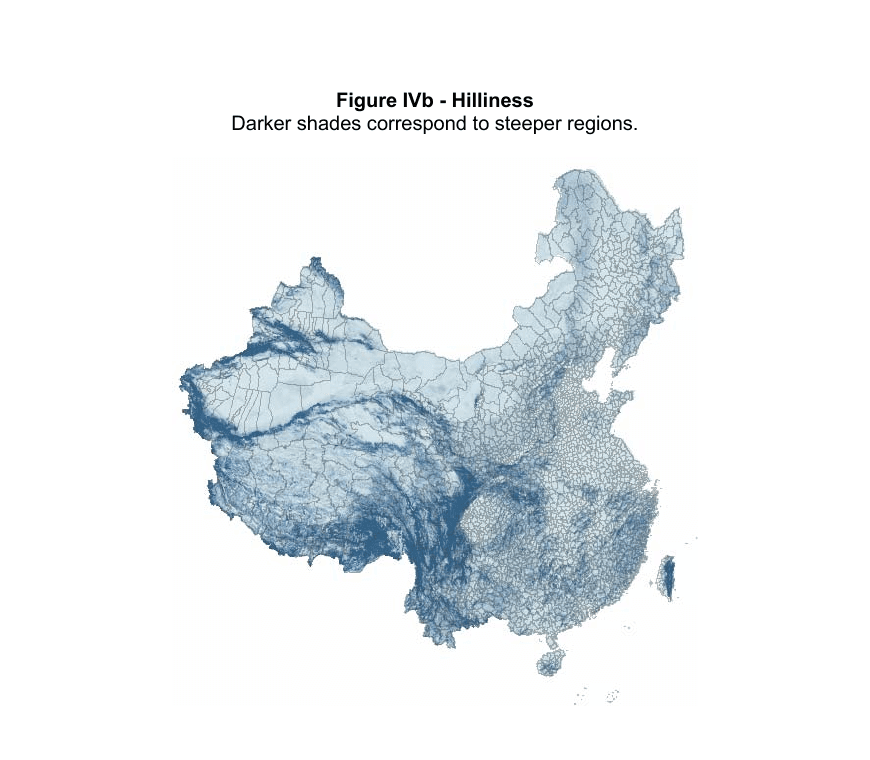
The design compares cohorts born before and after the reform across counties with different crop exposure. Hilliness is then used as an instrument for tea planting because steep land predicts tea suitability. Geography strengthens the case that crop choice was not simply a proxy for pre-existing attitudes toward girls, but it does not eliminate every possible contemporaneous change.
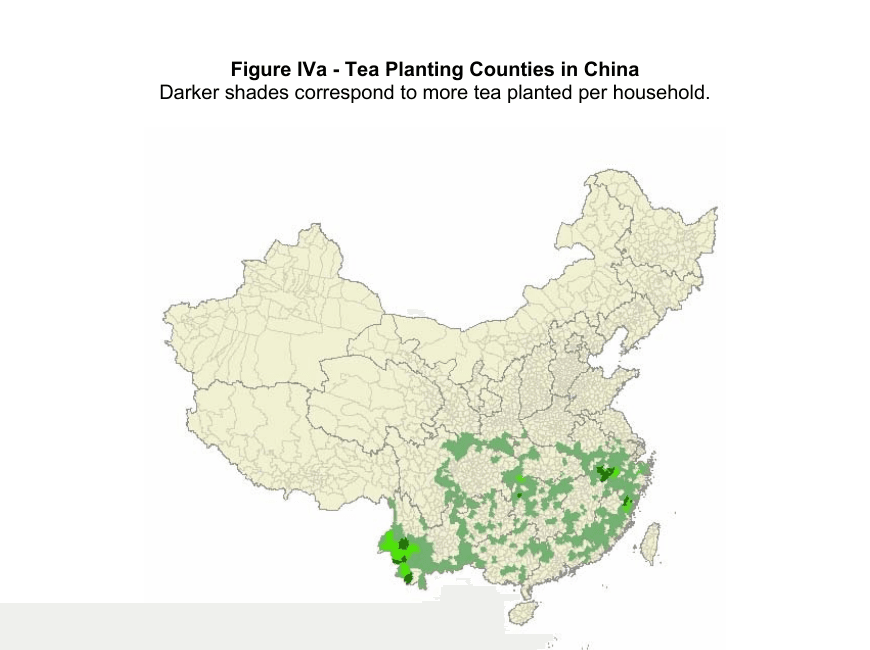
Figure 3
The geography behind the instrument
Tea planting clusters in parts of southern China. Qian uses hilliness as an instrument because steeper land predicts tea cultivation, while the income shock itself arrives through the national crop-price reform.
Results
When one adult’s income rises and the other’s is held constant
Figure 2
Reported child outcomes, by who earned the additional income
Hover, tap, or focus a row. Tap again to clear the selection.
Qian (2008), headline estimates and Tables III–IV. The female-income magnitudes are reported in the paper’s summary; male-income results are shown directionally because the exact coefficient changes with the crop measure and specification. Survival effects are percentage points; education effects are years, so these rows should not share a numeric bar scale.
When Female Income Rises
Survival rates for girls increase
Education for all children increases
When Male Income Rises
Survival rates for girls decrease
Education for girls decreases
No effect on boys’ education
Increasing annual adult female income by US$7.70 (10% of average rural annual household income) while holding male income constant increased the fraction of surviving girls by one percentage point and improved educational attainment by approximately 0.5 years (Qian 2008, Tables III–IV).[1] Increases in gender-neutral cash-crop value did not produce the same pattern. In this setting, the evidence points to the composition of household income—not merely its level—as an important mechanism.
Method & Data
Design
Differences-in-Differences
Pre/post reform cohorts, between tea-planting and non-tea counties. County and cohort fixed effects.
Data
1990 Population Census
RCRE National Fixed Point Survey (1993) for labor patterns. Ministry of Agriculture for crop data. Cohorts born 1970–1986.
Instrument
Hilliness of terrain
Tea grows on warm, semi-humid hilltops. 2SLS specification uses geographic suitability as an IV for tea planting.
Identification Checks and Remaining Assumptions
No visible differential pre-reform pattern. Figure IIIb shows tea counties generally had more boys before reform and fewer afterward. That supports the DID timing, though it is not a proof that every unobserved trend is absent.
Migration was tightly restricted. China’s migration controls reduce the scope for households to sort rapidly into tea regions in response to the reform; they do not make mobility literally impossible.
Prenatal selection was unlikely to dominate. Sex-revealing technology was unavailable to the vast majority of rural China during this period. That makes post-birth allocation a plausible channel, not an exclusively proven one.
A useful placebo. The tea pattern does not appear for non-agricultural households in the same counties. That weakens broad county-level explanations that should affect agricultural and non-agricultural households alike.
The Elephant in the Room
Why Not Infanticide?
The phrase “missing women” inevitably raises the question of infanticide: sex-selective killing of newborns, historically documented in China and elsewhere.[3] It’s the right instinct. But Qian’s paper isolates a different channel: differential neglect.
Infanticide
Active decision at birth. Binary: keep or kill. Historically documented but not what Qian’s identification strategy captures.
Sex-Selective Abortion
Prenatal decision. Less likely to drive these cohorts because sex-revealing technology was unavailable to most rural households, but not logically impossible in every case.
Differential Neglect
Resource allocation over early childhood: food, medical care, and other investments. The cohort timing is consistent with this channel.
The timing can reach children born shortly before the reform because neglect operates over the first years of life. That is consistent with nutrition and healthcare allocation, while a pure at-birth mechanism would affect only later cohorts. The paper does not directly observe the household decision, so “consistent with” matters here.
The practical insight survives that uncertainty: some of the missing-girl margin appears responsive to economic incentives and to who controls resources inside the household. That gives policy a lever without pretending the paper identifies every pathway behind the sex ratio.
Threats to the Claim
What the evidence survives—and what remains vulnerable
Tested in the paper
- Gender-neutral cash crops: they do not produce the same sex-specific survival and education pattern.
- Non-agricultural households: they do not show the tea effect, weakening broad county-level stories.
- Timing: the tea/non-tea relationship reverses around the reform rather than simply preserving the pre-period gap.
Not fully ruled out
- Changing attitudes: the paper explicitly cannot eliminate a tea-county attitude shift that happened at the same time as reform.
- Precision: some survival estimates are only modestly precise; the hilliness IV with county trends has a similar sign but is not statistically significant.
- Measurement and reach: crops proxy for sex-specific income, and rural China in this period is not every household bargaining setting.
The Craft
What the Design Buys
01
A shock outside the household
The price reform changes earning opportunities without beginning from a family's chosen allocation.
02
A built-in comparison
Tea, orchards, and gender-neutral cash crops help separate the level of income from who is positioned to earn it.
03
A mechanism you can inspect
Labor patterns, crop suitability, cohort timing, and placebos make the argument visible rather than purely statistical.
The paper is strongest as evidence that the identity of the earner can matter in this institutional setting. It is weaker as a universal claim that total income never matters or that every household follows the same bargaining model.
So What
The Portable Insight
Economic structure can change demographic outcomes by changing bargaining power inside a household. The level of income still matters; this paper shows that the identity of the earner can matter too.
The idea travels to other settings where several people share resources but do not necessarily share preferences:[4] education spending, elder care, or investment inside a firm. The portable question is not “does money matter?” It is “what changes when control over the marginal dollar changes?”
The Clean Takeaway
The same additional income can change a child’s life differently depending on who is positioned to earn it. Qian’s design makes that household power visible without claiming the evidence is cleaner than it is.
Sources
Primary Paper
[1]Qian, Nancy. “Missing Women and the Price of Tea in China: The Effect of Sex-Specific Earnings on Sex Imbalance.” The Quarterly Journal of Economics, Volume 123, Issue 3, August 2008, Pages 1251–1285.
Foundational References
[2]Sen, Amartya. “More Than 100 Million Women Are Missing.” The New York Review of Books, December 20, 1990.
nybooks.com →Author
Nancy Qian is the James J. O’Connor Professor of Managerial Economics & Decision Sciences at Northwestern University’s Kellogg School of Management.
Faculty page →